Tag Archives: Nicola Benedetti

Linehan’s EIF Swansong

Fergus Linehan talks to Keith Bruce as he launches the programme for his final Edinburgh International Festival.

When he stood to unveil the line-up for the 75th edition of the Edinburgh International Festival to Scotland’s arts journalists, director Fergus Linehan revealed his personal delight in being able to introduce a full-scale live public event for the first time in three years when he spoke for the whole industry.

Edinburgh, he said, was “the mothership of festivals – and that gathering is something that our whole industry has really missed.”

“While we are obviously concerned about the actual shows that we are putting on, the assembly that takes place every August is incredibly important for an industry that has been through something really difficult.”

“All the signs are that everyone is coming back this August. It will be a big moment for cultural life, not just for Edinburgh but for the whole of performing arts.”

Linehan has made “Welcome” – usually in friendly black capitals on a yellow background – the one-word slogan of Edinburgh. This year, it is both “Welcome back” and “Farewell” from the Irish director, after eight years in post, the last few dealing with the challenges of the health emergency.

He has taken the Festival into areas – particularly popular and alternative experimental music – that it had not visited before, and his legacy will take time to come into focus, but how does he see his own contribution to the EIF’s development as he hands over the reins to his successor, Nicola Benedetti?

He begins by saying he concurs with his predecessor, Sir Jonathan Mills, that Edinburgh “is good at picking Festival Directors for its time.”

“The Edinburgh Festival doesn’t move in fits and starts but it does change, and the question is how do you loosen the Festival and allow it some flexibility – because we are in a slightly more informal world – while maintaining the rigour.

“I think we have managed that. Some people might say: ‘You’ve loosened it too much’, but I like to think that the person coming after has a bit more flexibility to do what they will – and I hope that Nicky feels that.

“After the last two years, most of the team is still in place and we are able to come out with a full programme. What we did last year was limited compared to a normal year, but I am really proud that we did manage it at a time when it was still touch-and-go whether you could do anything.”

It has also meant that Linehan departs with the Festival in respectable financial shape.

“We raised a lot of money over the period of the pandemic so that we could do last year with tiny audience capacities. And we weren’t doing fully-stage opera and theatre, and we weren’t flying in many people to the city, so there were savings. For now the Festival is in reasonable condition; we are not carrying any deficit.”

From Benedetti’s point of view, what Linehan believes about the core concern of the Festival is probably crucial.

“Music is at the very heart of the Festival and you expand out into other genres in a meaningful way. It is not a theatre or a dance festival, and that is important in the balance with Edinburgh’s other festivals. The Traverse will always have significant theatre offerings. The music at the International Festival is sort of non-negotiable.

“But beyond that, there is maybe more flex than I realise, and looking back I now see there’s more flex than I thought. One of the great things about our supporters is that they are not prescriptive, whether its donors or Creative Scotland, it is not a completely blank sheet of paper, but it is never ‘you must do these 10 things.’ There are strategic goals we have to meet, but there is great flexibility.”

Although he says no-one believes him, Linehan is adamant that he has no new job lined-up, despite lots of offers.

“We are moving to Australia, for purely personal reasons because my wife’s family is there, but I have no masterplan.”

That’s because, he insists, he is unconvinced that jobs like the one he is vacating are the way forward for the arts.

“I am not tired, but I do want to have a look around and get a sense of the way things are going to be. There are obviously these big environmental, sustainability questions, and questions about what leadership in the arts should look like, and the future of the producer/director polymath who tells everyone what to do!”

He laughs, but he is making a serious point. “I am not sure that jumping in as the director of a big company with hundreds of employees is what I want to do right now, because I think things are shifting. People will always need support and there is always work to be done, but maybe it is going to be constituted in a different way in terms of leadership.

“It is an interesting time to get a sense of what way the wind is blowing generally. There have been huge changes in terms of the arts, and in particular the subsidised arts, and where they are going.”

And he thinks he owes that recalibration to his family as well.

“On a personal level, this job is all-consuming and a little bit more 50/50 with my wife is sensible. In 2019, I was away from home about 50 times, so that’s every week. I am not saying ‘poor me’, it was amazing to do all that, but there is a personal balancing up that’s important.

“And I have got a lot of the summer to think about it – because I don’t need to be working on the 2023 Festival!”

The Edinburgh International Festival runs from August 5 – 28. General booking opens on April 8.

eif.co.uk

Benedetti to direct EIF

Scots violinist Nicola Benedetti is to be the 11th director of the Edinburgh International Festival, succeeding Fergus Linehan, who steps down after this year’s 75th anniversary programme.

In a surprise announcement, less than 24 hours after the EIF had buried the controversy around its Russian Honorary President Valery Gergiev by accepting his resignation, the Festival’s appointment breaks new ground in a remarkable list of ways.

When she takes up the post of October 1 this year, Benedetti will be the first woman in the role and the first Scot to lead the Festival. Turning 35 in July, she will also be the youngest holder of the position since Robert Ponsonby in the 1950s.

In the public eye since she won the BBC Young Musician competition in May 2004 at the age of 16, playing Szymanowski’s First Violin Concerto with the BBC SSO in Edinburgh’s Usher Hall, Benedetti has carved a hugely successful international career as an orchestral soloist and chamber musician, with a succession of chart-topping recordings. Most recently she has been celebrated for her championing of music education, notably through the establishment of her own Benedetti Foundation. The youngest recipient of the Queen’s Medal for Music in 2017, she was made a CBE in the 2019 New Year Honours.

Currently on a tour of Europe which opened at London’s Wigmore Hall, playing Schumann and Brahms with her regular trio of cellist Leonard Elschenbroich and pianist Alexei Grynyuk, the violinist was unavailable for interviews. The statement from the Festival said that “alongside her role as Festival Director, Nicola will continue to perform internationally and to lead the Benedetti Foundation. She will naturally be more selective with her engagements in order to ensure she fulfils each of her commitments.”

The Director Designate herself was quoted: “I am deeply honoured to contribute to the long and rich history of the Edinburgh International Festival and the cultural landscape of Scotland. This festival was founded on principles of reconciliation and the ideals of art transcending political and cultural fracture. Following in the footsteps of the wonderful achievements of Fergus Linehan and his predecessors, I will uphold these values and greatly look forward to serving this festival, its mission of cultural exchanges, and the people of Scotland.”

Scotland’s First Minister, Rt Hon. Nicola Sturgeon MSP, said: “I’m sure that people across the country are looking forward to supporting the Festival’s full in-person return after two years, and welcoming visitors and artists from around the world to Scotland.

“I welcome Nicola Benedetti’s appointment as Director – especially as she becomes the first woman to ever hold the role. Her experience in promoting Scotland’s cultural scene to audiences around the world will be invaluable and I wish her every success.”

Keith Skeoch, who chairs the EIF Board of Trustees, added: “It is such a pleasure to welcome Nicola Benedetti as both the first woman and the first Scottish director of the Edinburgh International Festival. In many ways she reflects the spirit of this festival; internationally recognised and respected but Scottish to her core, she’s dedicated to advocating world-class music making and innovating new ways to bring it to audiences.

“As an artist, her string of collaborators reads like a who’s who of the world of classical music and as an educator she has reached tens of thousands worldwide. I have no doubt that she will bring a wealth of new ideas to the organisation and build on Fergus’ exceptional work from the last eight years.”

Benedetti’s predecessor will unveil his final programme at the end of March. The 75th Festival follows two years when the presentation of events was impacted by the global pandemic, becoming mostly filmed and online in 2020 and with the construction of three tented pavilions to house the 2021 music programme.

During the same period, Benedetti moved much of her education work online but has also performed acclaimed new orchestral works written for her by Wynton Marsalis and Mark Simpson, and formed her own early music ensemble, Benedetti Baroque, which appeared at last year’s Festival.

The Festival’s Board yesterday announced that it had asked for and accepted the resignation of Valery Gergiev as its Honorary President. Arts organisations across the world have distanced themselves from the Russian conductor since the invasion of Ukraine because of his friendship with President Putin

This year’s Edinburgh Festival runs from August 5-28, and more information is available at eif.co.uk.

SCO / Benedetti

Perth Concert Hall

There are some programmes that can appear a somewhat surprising fit, and here was one of those. A pre-Vienna Mozart, exploring the possibilities of the violin concerto with the experience of his early catalogue of grander works, sitting comfortably amongst music from the Austrian city in a state of flux over a century later by Johann Strauss II and Arnold Schoenberg – the latter as revised in the mid-20th century.

The coherence of all this was entirely a virtue of the ensemble performance. Violinist Nicola Benedetti may be the name that sells the tickets – alongside that of Wolfgang Amadeus Mozart – but there was nothing of the star vehicle about this concert. Even for the Mozart, when she stood in front of the band, Benedetti was always immersed in the ensemble sound, right down to the cadenzas in each movement, which she was at pains to integrate into the flow of the music.

Benedetti now plays in a style much closer to that of Baroque specialists than earlier in her career, although still with a little more theatre than some of the historically-informed performance brigade. Her first movement cadenza was a case in point – more about the music, less the violin-playing.

In the hands of the players of the Scottish Chamber Orchestra, of course, the work could hardly be safer, and the balance of the strings and the four winds was exemplary.

The concerto was surrounded by examples of exquisite musical story-telling, and Benedetti was even more the ensemble player in Schoenberg’s Verklarte Nacht, leading the strings from the front-desk alongside the concert’s co-director Benjamin Marquise Gilmore. This orchestrated chamber work was sumptuous stuff, beautifully performed in an acoustic that suited it perfectly. With SCO first cello Philip Higham and other front-desk players joining Benedetti in the soloing duties, and a beautiful sectional balance throughout its half-hour, it was a superb account of a sensational work.

Gilmore took charge of the Strauss, which gave the concert the liveliest of starts as well as a party finish. Here were opportunities for the SCO’s wind soloists to grab a slice of the action, with flautist Andre Cebrian stealing the honours in the closing Tales from the Vienna Woods. His solo is only a few bars before the tune everyone knows eventually bursts forth and with brass and percussion bolstering the sound, the melody is given every opportunity to worm its way into the brain.

There are also plenty of hooks in Strauss’s Overture to The Gypsy Baron, which opened the concert. While it is concerned with a very specific, if fantastical, story, the musical tale the whole concert told was no less compelling.

Keith Bruce

Go-ahead for music school

Councillors on the Finance and Resources Committee of the City of Edinburgh Council have given the go-ahead for the development of the Old Royal High School on Regent Road as a new home for St Mary’s Music School and a public performance venue.

With the decision to grant the Royal School Preservation Trust a long lease on the historic building, the city council has signalled its approval of the plans to develop it as a national centre for music education.
The bid is backed by an expanded gift from philanthropist Carol Colburn Grigor and Dunard Fund totalling £55 million to cover the capital costs and support the future maintenance of the Thomas Hamilton building.

Announcing the decision, committee convener Councillor Rob Munn said: “It’s great news that this iconic building, set in the heart of our World Heritage Site, will now be restored and put to good use again, making it accessible for many generations to come.”

William Gray Muir, Chairman of the Royal High School Preservation Trust, said: “We are thrilled that our shared vision for a new world-class centre for music education and public performance can move forward at last.  

“The project has brought together an unprecedented range of partners, all of whom recognise collaboration as the key to realising Scotland’s potential as a world leader in music education, and creating an entirely new way for the nation to engage with and enjoy classical music.”

Dr Kenneth Taylor, Headteacher at St Mary’s Music School, added: “This is a truly exciting day for St Mary’s Music School. Not only does it bring us a huge step closer to having a new home for the school; it also places us at the centre of a project that will deliver and enhance world-class music education for people from all backgrounds across Scotland in a setting that will be second to none.

“We are also enormously grateful for the ongoing support of our stakeholders in the world of arts and education, as well as the people of Edinburgh who have backed us warmly over the past five years.”

Supporters of the plan include Impact Scotland, which is developing the new Dunard Centre in the city, which will be a home for the Scottish Chamber Orchestra, and Nicola Benedetti’s Benedetti Foundation which has done so much to boost music education in recent years.

The violinist said: “The National Centre for Music presents us with an unprecedented opportunity to enrich the cultural life of Scotland and to serve as a beacon of true 21st century music education for the world to see.”

Picture: Students of St Mary’s Music School in front of the Old Royal High School, credit Mike Wilkinson

RPS Awards

There has been much understandable mutual congratulating on social media in Scotland after the announcement of the shortlists for the 2021 Royal Philharmonic Society Awards. The pioneering spirit of music-making in Scotland is well represented, and there are Scots in the running in many categories.

Conductor Paul MacAlindin, founder of the Govan-based Glasgow Barons orchestra, is up against veteran director of Ex Cathedra Jeffrey Skidmore and Royal Conservatoire of Scotland alumnus now at BBC National Orchestra of Wales Ryan Bancroft in his category.

Tenor Nicky Spence is nominated in the Singer category, where his rivals are mezzo Jennifer Johnston and Scottish Opera’s Alice Ford in Falstaff, Elizabeth Llewellyn.

Violinist Nicola Benedetti is nominated for the Instrumentalist award, and the concerto written for her by Mark Simpson is up for Large Scale Composition.

The Ensemble award boasts two nominees in the Dunedin Consort and the Nevis Ensemble and the Inspiration award includes nominations for Orkney Camerata and Orkney Winter Choir, and Aberdeen Saxophone Orchestra for its online partnership with the Phoenix Saxophone Orchestra of Market Harborough in Leicestershire.

The winners will be announced at a ceremony in London’s Wigmore Hall on November 1.

royalphilharmonicsociety.org.uk/awards/rps-awards

Pictured: Orkney Winter Choir and Orkney Camerata rehearsing in St Magnus Cathedral

EIF: The Soldier’s Tale

Edinburgh Academy Junior School

Normally it’s just the forces of evil that performers have to deal with in Stravinsky’s satanic music theatre piece The Soldier’s Tale. In the first of Saturday’s two EIF performances, however, the forces of nature had an equal stake in the outcome. Torrential rain battered off the taut roof of the giant Edinburgh Academy tent, cascading over its open sides, adding an apocalyptic dimension to a performance that was already doing pretty well on its own.

This was the last of three programmes in violinist Nicola Benedetti’s week-long Festival residency, which cast her in a more democratic role as equal participant in a roll call of three actors and seven musicians. Not that she failed to showcase her own presence. Her fiery red attire made a distinctive impression against her more sombrely-clad colleagues.

Yet this was a starry cast right across the board. Joining Benedetti was a hand-picked premiere league of instrumentalists, among them names familiar to Scots audiences, such as clarinettist Maximiliano Martin, bassoonist Ursula Leveaux, double bassist Nicholas Bayley and percussionist Louise Goodwin, all either present of past members of the SCO.  Add to that a speaking cast of veteran baritone/opera director Sir Thomas Allen as the narrator, fellow singer Anthony Flaum as the Soldier, and actor Siobhan Redmond as the Devil, working to a simple but cutting presentation devised by Allen.

Stravinsky’s piece, in which a naive soldier falls prey to the devil’s trickery, is a wonderfully gauche  parable, spelt out in the acerbic, often grotesque parody of the musical score, and tersely voiced in the script’s well-worn English translation by Michael Flanders and Kitty Black. Thank goodness for the surtitles, though, which compensated those moments in which Allen’s otherwise lyrically-intoned narration, albeit amplified, was obscured by the ensemble, or when that intervening deluge threatened to drown out the entire cast.

Otherwise, this was a slick and captivating show. Flaum’s happy-go-lucky Soldier proved a convincingly wretched foil to Redmond’s manipulative, chameleon-like performance, her variable personae distinguished by a shifting repertoire of accents. Interaction with the music was vital and seamless, Benedetti leading an ensemble whose animated incision made easy meat of Stravinsky’s mischievously virtuosic score, brilliantly capturing its catchy, bittersweet irony. 
Ken Walton

EIF: The Story of the Violin

Old College Quad

If it seemed surprising that the Festival was still advertising tickets for sale for Nicola Benedetti’s solo turn at this year’s event on the day before the performances, then that was possibly because it was not what I had expected. It may be my mistake, but I had assumed that “The Story of the Violin” would be Nicky in her education persona with a family show about the history of her instrument and its pivotal place in the development of music. Instead, and not in any way second-best, the title masked a recital of solo repertoire, virtuosic stuff that spanned 250 years of composition.

It was, in fact, exactly the sort of thing a festival’s “artist in residence” might be expected to perform, between her concerts of early Italian repertoire and music by anniversary year composer Igor Stravinsky. There was no script and very little narrative, and, as she admitted at the start, the real “story of the violin” was a much bigger and longer one than she could attempt to tell in an hour.

It was, nonetheless, A Story of the Violin, illustrated with examples of how far four composers have pushed the instrument and the skills of players. Benedetti was hardly idle during lockdown, but it is not fanciful to imagine that she spent some of her time at home honing these demanding solo pieces, and they did have a story to tell.

She began with a Passacaglia from Biber’s Rosary Sonatas, which Rachel Podger memorably performed complete in St Cecilia’s Hall at the last live Edinburgh Festival in 2019, juggling a selection of instruments in different tunings. Virtuoso playing notwithstanding, and sensibly in standard tuning, it was really just a warm-up for the epic Bach Chaconne, from the Second Partita, that followed. It is one of the pinnacles of the violin repertoire, but Benedetti did not treat it as in any way a technical demonstration, being just as concerned with communicating the design of the whole piece.

There was a music stand on stage, but the violinist consulted it very sparingly during her recital, and not at all during the 20 minutes or so of the Bach. This was a programme that has to be memorised and in the fingers to be performed at all – reading the music is not really an option.

That is just as true of the Paganini that followed, the first and last of his 24 Caprices, the final one the most re-used (and sometimes abused) works in the whole history of music. Its violinist composer may indeed have been the “trickster and dramatist” Benedetti described, but she was concerned to let us hear this tune in its original authentic form, not as a mere party-piece. And if Niccolo Paganini really did invent the “Good Evening, Friends” musical sign-off at the start of the 19thcentury, I am not sure I’d appreciated that before.

Concluding with the solo Sonata No 5 in G by Eugene Ysaye from a further century on, and about 100 years ago, was to demonstrate how the techniques Paganini pioneered were put to the service of a new sound world that we are exploring yet. It also showed that the Belgian invented the “unsquare dance” a long time before Dave Brubeck took five.

Keith Bruce

EIF: Benedetti Baroque

Edinburgh Academy Junior School

Who knows what caused Nicola Benedetti to fight back the tears as she introduced the first of the two repeat Saturday shows that opened her Edinburgh International Festival residency this week. It was certainly out of character. Benedetti is known for her confident, commanding stage presence. She seemed lost for words before proclaiming: “I don’t know what’s come over me.” Best get on with the music, advised a voice from the audience. She did, and the atmosphere settled.

This was Scotland’s first sighting of the Ayrshire violinist’s Benedetti Baroque Orchestra, which recently released a new disc on Decca and has subsequently been performing its mostly-Vivaldi programme south of the border. The orchestra, specialists in the period instrument field, are few in number – a mere dozen including its eponymous star – with some recognisable Baroque veterans among its ranks. So Benedetti, as “frontman”, had potentially solid back-up.

From the outset – Geminiani’s Concerto Grosso in D minor (its moniker “La Folia” crediting the Corelli Sonata it is based on) made for a lusty opener – the stylistic ambition of this group was self-evident. It’s about the heart and soul of the Italian Baroque. For Benedetti – whose mother, she informed us, was from the same region that reared Vivaldi – that’s “about the people”. There was certainly a feisty humanity informing the animated performances that variously laughed, cried, danced, took risks. 

Three successive Vivaldi concertos followed the Geminiani: the D major Concerto, RV211, ablaze with Baroque laissez-faire even in its central lilting siciliano-styled Largo; the B minor, RV386, more richly emotive but still with a sunny countenance; and one of the famous Four Seasons, appropriately “Summer” – apparently requested by the Festival – to take the programme to its official conclusion. 

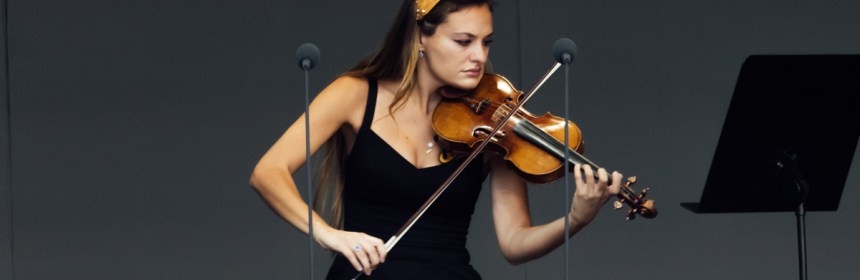
In each of these Benedetti’s personality was the driving factor, visually balletic, rhythmically electrifying and full of idiosyncratic surprises, from the provocatively sensuous bending of phrases to improvised cadences that defied expectation, and much to the thrill of the unsuspecting listener. That her errant hairband chose to adopt a life of its own, leading to another impromptu announcement, merely added to the spontaneity.

That said, a niggling discomfort pervaded this programme. Benedetti, herself, suffered moments of technical insecurity, with iffy upper intonation in key exposed passages, and a tendency, now and again, to lose firm focus in her tone. Her orchestra, super-efficient and ever-watchful of its director, seemed mostly content to play a back-seat role when the opportunity was there to throw in its own characterful surprises, more amorphous than distinctive. That seemed a missed opportunity.

Suddenly, though, all cylinders fired in the expected encore, the gorgeous Largo-Andante from Tartini’s A major Violin Concerto. Not in an all-guns-blazing way, of course, for this is one of those hushed, sun-baked Italian Baroque slow movements that flow with instinctive purpose and floating inevitability. Benedetti, wholly at ease with its natural melodic thread and inspiring melting support from her colleagues, now seemed perfectly at home.
Ken Walton

Image: Nicola Benedetti credit Ryan Buchanan

RSNO / Chan / Benedetti

Glasgow Royal Concert Hall

Regardless of the many obstacles that have had to be overcome, the RSNO has maintained the shape of its programme of work over recent months with a tenacity that does the organisation much credit. And as they have done since live performances were abruptly silenced in March 2020, the players of Scotland’s national orchestra step up to the plate here with thoughtful contributions to the online world, joining conductor Elim Chan and soloist Nicola Benedetti in making interesting spoken contributions to this concert film, as well as playing their socks off.

With a return to performing for audiences scheduled for next weekend in Perth and Glasgow, this concert neatly wraps up the current digital season, Benedetti returning as soloist for Szymanowski’s Violin Concerto No 2 (having opened the series with No 1). That work completes the Polska Scotland strand of the season, while Christopher Duncan’s Stac Dona, which precedes it, is part of the Scotch Snaps strand.

Like the Craig Armstrong piece in April’s last concert, the latter is from the Lost Songs of St Kilda project, arranged by a young composer better known under his pop alias, C Duncan, whose parents have played with the orchestra and whose aunt still does. Scored for strings and harp, it is a very filmic, romantic piece that makes the most of its folk melody.

The Szymanowski also springs from its environment, Chan notes, in particular the mountains of Poland. This may have been the first time she and Benedetti had worked together, but both women are so familiar with the orchestra that introductions were unnecessary. Beginning with a rumbling piano chord and a duo of clarinets, it is a work that quickly becomes very intense, and virtuosic for the soloist, with powerful scoring for horns, brass and percussion.

A single 20-minute movement, its cadenza may be the work of the piece’s dedicatee, violinist Pawel Konchanski, but it is very much of a piece with the atmospheric and picturesque whole. This is a full-blooded performance, with some sparkling dialogue between Benedetti and the wind principals, and some gorgeous playing on the lower strings of her instrument on the Andantino before the frenetic dance of the finale.

Many of these elements mirror parts of Bartok’s Concerto for Orchestra, in what is another ingenious piece of programming, with the virtuosity now being required of everyone on the platform. This is a work that needs the orchestra’s return to the big hall, with the brass in the choir stalls, but it is also intricate, and Chan recognises the dangers of losing sight of the bigger picture when she speaks of taking an approach that is “not nerdy”.

The gentle beginning here is on the low strings, and if the Szymanowski is a political work with a nationalist agenda, Bartok is internationalist, if no less political, writing in the middle of the Second World War and after the diagnosis of the cancer that would kill him. The brooding, mystical third movement may be indicative of his state of mind, but it is surrounded by the distinctive staccato rhythms of the second and the musical japes of the fourth. And just as Benedetti had danced us home, the Presto finale trips fantastically to the last bar.

Keith Bruce

PERTH FESTIVAL: Benedetti & SCO

Perth Concert Hall

One of the constant enjoyments in life is to listen to the Scottish Chamber Orchestra playing Mozart. It’s tradition for them that goes back to the James Conlon recordings of the early 1980s and continues today under the likes of current chief conductor Maxim Emelyanychev. There have been times, too, when this finely-tuned orchestra has simply self-driven itself through Mozart, as it did with the in-house guidance of leader Benjamin Marquise Gilmore in this closing online concert of the Perth Festival.

And this Mozart delicacy – the short, light-fingered, Italianate No 33 – was much more than a warm-up to the starry appearance of Nicola Benedetti in Mendelssohn’s Violin Concerto that was to follow. In its own right, it had poise, the graceful triple-time opening Allegro, the soothing Andante, the downward swooping Menuetto and the pert Finale, all enlivened by shapely poeticism and a neatly-textured ensemble. It wasn’t the most flawless performance in terms of absolute togetherness, but in spirit it was a confectionary delight.

Benedetti may only be in her early 30s, but she carries her own lengthy and busy tradition of playing the Mendelssohn concerto, which – she recounted in her introductory remarks – featured in the last set of SCO performances she undertook before last year’s lockdown. 

So there was an obvious pertinence in returning to it here as the music world begins to reopen. A palpable optimism seemed to inform Benedetti’s performance, which bristled with intent from the word go. If this is a work that engenders impetuosity – there’s a fair argument for that – it was dealt here in spades, but with all the affectionate sincerity and heartfelt lyricism it deserves.

Was Benedetti’s response a little roughshod at times? To an extent, perhaps, in the heat of the opening movement, but there was consistency, wholehearted conviction in her playing, which in turn fed into the robust orchestral support. The melting tenderness of the Andante, opulent without labour or indulgence, was charming; the finale, joyous and liberated. 

That should have been the upbeat conclusion to the 2021 Perth Festival, were it not for an unexpected encore: Sally Beamish’s natty arrangement for violin, viola and orchestra of Peter Maxwell Davies’ Farewell to Stromness. Benedetti was joined front stage by principal viola Nicholas Bootiman, in a version stage-managed like Haydn’s Farewell Symphony, the musicians disappearing one by one, leaving only the duo under the lone spotlight, Max’s wistful melody drifting softly into the distance. 
Ken Walton

Available on the Perth Festival website till 7 June. 

RSNO: Søndergård / Benedetti

RSNO: Søndergård & Benedetti
Glasgow Royal Concert Hall

The story of Poland is a volatile one. So it is inevitable, even in the very first programme of an intermittent Polska Scotland mini-series which runs through the RSNO’s new digital summer season, that some of its music should reflect that historic turmoil.

The opening concert, which now sees the orchestra relocated to the de-seated stalls area of the main Glasgow Royal Concert Hall auditorium, enabling the  deployment of a larger contingent of socially-distanced players, is a welcome sight and sound. Moreover, it paves the way for more expansive programming. 

In this case it is music by Mieczysław Weinberg, Karol Szymanowski and Andrzej Panufnik, a strange but intriguing mix of style and influence (musical and political). In charge is RSNO music director Thomas Søndergård, with Nicola Benedetti as soloist in Szymanowski’s Violin Concerto No 1 (she returns for the second concert at the end of the series), the piece that secured her the career-launching 2004 BBC Young Musician prize.

That was 17 years ago, and it’s a more musically mature Benedetti who garners every ounce of lyrical passion and glistening heat this time round. There is also a wonderful air of composure in her performance, no better illustrated than the floating, timeless initial entry that instantly becalms the orchestra’s restless introduction.

Thereafter, the journey is one of mercurial fascination, expansive eloquence, crisp virtuosity and melting, poetic beauty. Søndergård exerts his own authority where the opportunity presents itself, from rip-roaring orchestral climaxes to the breathiest of moments, where time stands still. But this is triumph of partnership, no better illustrated than in the ethereal melting away of the final bars.

The east-west tug-of-war affecting Poland in the 20th century sent artists in various directions. For Weinberg, after fleeing the Nazis in Poland, the ultimate draw was Moscow, encouraged there by Shostakovich whom he admired greatly. There’s no mistaking the latter’s influence, nor Weinberg’s Jewish heritage, in the Rhapsody on Moldavian Themes, which opens this programme.

From its growling lugubrious opening there is a lingering shadow of nostalgia, even where Weinberg opens the floodgates and unleashes the full orchestral might. That hint of suppressed rapture permeates this mostly trenchant RSNO performance, with only a suggestion of nervousness from the exposed violins in their opening bars.

For Panufnik, the escape route from Soviet-run Poland led west, defecting to the UK in 1954 and leading a successful life as a conductor and composer up to his death in 1991. His Symphony No 3, Sinfonia Sacra, was written in 1963 to mark 1000 years of christianity in Poland. The RSNO gave the Polish premiere in Warsaw in 1968.

Based on the earliest-known Polish hymn, the Bogurodzica plainsong, there are two parts to the symphony: Three Visions and Hymn. With the RSNO brass standing aloft like heraldic warriors, their impact here possesses a thrilling undercurrent of menace. Søndergård plays on that, but equally on its haunting mysticism, at its most sublime in the quiet strings of the second Vision. He also shapes the drama in this powerful symphony with unstinting, ultimately overwhelming intent.
Ken Walton
Available to view via www.rsno.org.uk

Benedetti premiere

The world premiere of a new concerto written by clarinettist and composer Mark Simpson for Nicola Benedetti will be free to view on Thursday April 22 on Marquee TV and for seven days thereafter. The first performance of the work will be given by the London Symphony Orchestra with its Principal Guest Conductor Gianandrea Noseda on the podium.

The LSO is one of four partner co-commissioners of the concerto, along with the Royal Scottish National Orchestra, Germany’s WDR Sinfonieorchester and the Cincinnati Symphony Orchestra in the USA. The RSNO had been due to give the first Scottish performances on April 23 and 24 in Edinburgh and Glasgow as part of the season that was announced immediately  before the pandemic struck.

Benedetti is a featured soloist in the new digital season by the RSNO, playing concertos by Karol Szymanowski on April 16 and June 11, however the Scottish premiere of the Simpson concerto is now pencilled in for early in 2022. RSNO chief executive Alistair Mackie told VoxCarnyx that details were still to be confirmed, but a provisional date was being held in the soloist’s diary.

The concerto is of particular interest because Simpson and Benedetti are near-contemporaries whose early fame came through the bi-annual BBC Young Musician Competition. The violinist won at the Usher Hall in 2004, playing the Szymanowski’s Concerto No 1, and Simpson was the winner at the Sage, Gateshead, in 2006.

The decision by Mackie and the RSNO to postpone their performances raises interesting questions about concert scheduling as a result of the move to online streaming, and ones which may persist beyond the health emergency if orchestras build on the experience of making work available that way, as seems likely.

Previously, it would have been perfectly acceptable for a new work to be heard in front of a live audience in London, and then repeated for concert-goers in Edinburgh and Glasgow the same week. However, the RSNO felt that it could not broadcast its performance when the LSO’s would still be available to watch, especially, perhaps, as the London orchestra’s premiere is initially free to view, while the RSNO’s would have been part of a subscription season. Orchestral managements have yet another variable to take into account as they look to a future beyond Covid-19.

The LSO’s chief executive, Kathryn McDowell, has announced the Chief Conductor who will succeed Sir Simon Rattle. Another musical knight, Sir Antonio Pappano, will move from his current position at the Royal Opera House, where his contract ends in July 2024. Pappano will be styled Chief Conductor Designate at the LSO from September 2023 and take up the post a year later.

Keith Bruce

Recent Entries »