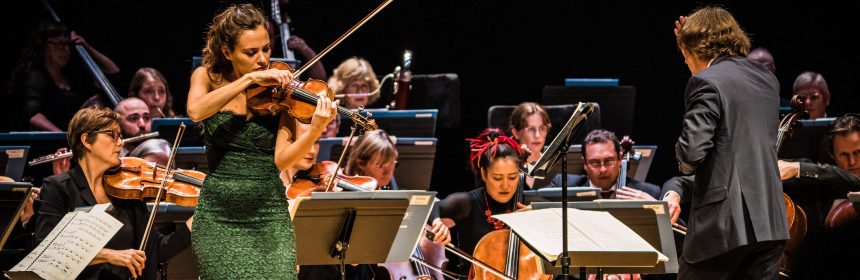
Scottish violin star Nicola Benedetti’s new group is not without antecedents. Guitarist Martin Taylor’s Spirit of Django, with veteran accordionist Jack Emblow, and its inspiration, the Quintet of the Hot Club of France, with violinist Stephane Grappelli, were jazz groups but the ensemble sound was similar.
Here, however, there is usually just the one soloist, the violinist herself, and that seems like a missed opportunity, not least because the exceptions stand out in the set. Sarasate’s Navarra may be a well-aired party piece, but duetting with violinist Yume Fujise – who has also joined the quartet on tour for that one number – lifts the track from the other violin party pieces on the disc.
The live dates also seemed to feature cellist Maxim Calver rather more prominently than Thomas Carroll, who is on the recording, but it is really guitarist Plinio Fernandes and the accordion of Samuele Telari that it would have been good to hear more of, for their own virtuosity at least as much as for the variety.
The other exception is the trio of tracks in the middle of the album arranged by and in duet with Brighde Chaimbeul and her Scottish smallpipes. Only one of these, Skye Boat Song, is well-known, and that benefits hugely from her fresh approach. The swerve into traditional music is less awkward than could have been predicted, but the sharing of the limelight is one of the strengths of that sidestep that might have been emulated elsewhere.
Sit Peter Maxwell-Davies’s Farewell to Stromness – in an arrangement by Paul Campbell – is a step on that road earlier in the album, and it is lovely to have Benedetti playing that and tunes like Ponce’s Estrellita, but sometimes the arrangements commissioned for the album – and the four-square production – make you long for a little more risk.
There’s nothing wrong with Violin Café, and it will doubtless fill many Christmas stockings, but it’s more cappuccino than a shot of espresso.
Some years ago I recall hearing violin showman Maxim Vengerov interviewed on BBC Radio 3’s In Tune, and Sean Rafferty asking if he was ever irritated by audiences coming to see him more for his virtuosic encore choices than the concertos orchestras contracted him to play.
Vengerov’s memorable reply was: “Well, you may go to a restaurant because it serves the best tiramisu, but you still have to eat.”
It might look as if Nicola Benedetti’s upcoming new album, Violin Café – and the current concert tour launching it – is in danger of serving a surfeit of desserts and no main courses, but that would be to underestimate the sound-world she and her new associates have created.
Italian accordionist Samuele Telari, Brazilian guitarist Plinio Fernandes, and cellists Maxim Calver (live) and Thomas Carrol (on the recording) may make the sort of informal ensemble the album title suggests, but the bespoke arrangements are mostly true to her classical education.
In fact some of them are the work of Stephen Goss, who was Benedetti’s theory teacher at the Yehudi Menuhin School, others by Paul Campbell, who does the same job for her Foundation’s education work, and the freshest by traditional music talent Brigdhe Chaimbeul.
An international star player of the small pipes, Chaimbeul is currently in the midst of tour dates of her own and free to join Benedetti’s group only for the Ulster Hall date at the start of December. Her place in Glasgow was taken by Fin Moore, who has followed in the footsteps of his father Hamish as one of Scotland’s top pipe-makers, and also taught Chaimbeul as a youngster.
That sense of legacy in the sequence of traditional tunes the quintet played at the start of this concert’s second half ran through the whole evening. Benedetti has talked about reconnecting with her core audience following the absences of the Covid pandemic, her work with the Edinburgh International Festival and her maternity leave, and that has gone hand-in-hand with her revisiting her own musical past and the repertoire she learned as a student of the violin.
So she was joined by a younger alumnus of the Menuhin school, Yumi Fujise, for the Pablo Sarasate duet, Navarra, a favourite test piece for young players to push one another on (which also features on the record). Henryk Wieniawski’s Polonaise de Concert is a similar sort of work, and a Niccolo Paganini sequence, which began with a solo Caprice, before the one Andrew Lloyd Webber and Melvyn Bragg made famous, and then the lovely Cantabile Op 17, was clearly in the same territory.
Significantly, though, there was a balance between the fireworks of the likes of Vittorio Monti’s Csardas and more gentle fare, like Claude Debussy’s Beau Soir, Manuel Ponce’s Estrellita (popularly revived by Benedetti Foundation associate Elena Urioste and her husband Tom Poster with their pandemic Jukebox recordings), and the encore of Paul Campbell’s arrangement of Sir Peter Maxwell Davies’s Farewell to Stromness.
It was a perfect way to end an evening that saw Benedetti embracing her past but eschewing nostalgia, and it would have been good to hear much more of Fernandes, for example, who came to the fore only at the end. There was a real sense that there could be much more to come from this ensemble.
Keith Bruce
Further dates at Ayr Town Hall (Oct 31), Bridgewater Hall, Manchester (Nov 19), National Concert Hall, Dublin (Nov 23), Royal Albert Hall, London (Nov 27), Lighthouse, Poole (Nov 29), Ulster Hall, Belfast (Dec 1) and The Royal Hall, Harrogate (Dec 4).
Scotland’s violin star, Nicola Benedetti, talks to Keith Bruce as she goes out on the road with a small group from this weekend.
Nicola Benedetti has hardly been idle, embracing motherhood and marriage alongside working with her educational foundation and directing Edinburgh’s festival, but she feels it is more than time to re-connect with her most loyal supporters.
“There has been a period, with all the work I have been doing for the Foundation and for the Festival, when I have not toured anything personal,” she told Vox Carnyx last week. “Most of the places I’ve played have been as a guest of an orchestra, or in my role at the Festival. So this is a bit of a reuniting with audiences that I have known for 23 or 24 years.”
She is speaking of her upcoming solo tour, which features the small group of musicians who also feature on her upcoming Decca album, Violin Café, scheduled for release on November 21.
The 14-date tour kicks off in Basingstoke on Sunday before a run of seven concerts in Scotland beginning in Dundee’s Caird Hall on October 15 and ending at Ayr Town Hall, 40 minutes down the A78 from her West Kilbride birthplace, on Halloween. More concerts across England and Ireland follow in November and December, including London’s Royal Albert Hall on November 27.
The violinist is keen to emphasise how much of a personal undertaking both the recording and the tour have been.
“I had several ideas up my sleeve about what to tour and how to tour, and two or three of them were postponed during Covid. In the past I’ve organised parts of tours myself and I wanted to do that again, in collaboration with my management, Askonas Holt, who have a fantastic touring arm to their organisation.”
In fact, she says, the intimate nature of the music came to her, if not in a dream, certainly from her subconscious mind.
“I knew I wanted to put something together around this style of repertoire, but the sound and the instrumentation actually came to me in the middle of the night and I woke up knowing how I needed to do it.
“It’s a bit of a hark back to a Mediterranean café where you might happen upon an accordionist or a guitarist and on occasion, more from the Roma tradition, a violinist too.”
The repertoire covered on the album, and to be featured on tour, is actually quite wide, including Pablo de Sarasate’s Carmen Fantasy, Manuel Ponce’s Estrelita, Peter Maxwell Davies’s Farewell to Stromness, and arrangements of Skye Boat Song and other traditional tunes by small pipes player Bridghe Chaimbeul.
It is far from all fresh territory for Benedetti, but the presentation of it by a small group in which her violin combines with the Italian accordion of Samuele Telari, Brazilian guitar of Plinio Fernandes and Welsh cellist Thomas Carrol is a new direction.
“It is a mix that includes things I haven’t played since I was 16 years old, but I wanted to do music that was light, vibrant and charming. These are pieces that you quite often learn when you are studying – they’re entertaining but rarely feature in the season repertoires of orchestras and concert halls.
“So all of the music has that sweetness to it, that bit of nostalgia, and with quite few virtuosic show-stoppers in there as well.”
The set was recorded in London’s Henry Wood Hall early this year by the same group of musicians and Jonathan Allen, a long-time Benedetti collaborator, producing.
“We’ve been talking about what would go on the album for some time and we did a bunch of little house concerts testing the repertoire, to find out what works in front of an audience.
“But I can never make decisions on anything until it is past the deadline, so I kept stringing out options until the last minute. There were definitely things that I wanted to have arranged for the group that didn’t make it.
“What that does mean is that there is a load of repertoire that isn’t on the album that we can come back to. I think the formation of those instruments works so brilliantly that we should. There’s a lot of textural interest and rhythmic flexibility, and there’s no issue with definition between the instruments, no instrument that over-powers another one. I couldn’t have asked for more in terms of how the group functions together.”
Although young strings students had the opportunity to play alongside her at the latest Benedetti Sessions tutorials by her Foundation in Glasgow Royal Concert Hall only last month, and she guested with visiting artists at the Edinburgh Festival in August, other places in her homeland haven’t heard her live in a long time.
“Half the tour is in Scotland and it is at least ten years since I’ve done as many Scottish dates” she said. “I chose all the touring venues, and they are places I’ve known since I was in my teens.
“There is so much in life now that is serious and tragic, and I hope this is an antidote to that. It’s going to give me an opportunity to stand up in front of people in an environment that is entirely presented by me, touring a beautiful collection of music around the country. I genuinely am very excited for this tour.”
She has brought much more to the role of Festival director, including surprises, but this was surely a concert that the panel who appointed Nicola Benedetti to that role hoped she would make happen.
The violinist’s acute awareness of the event’s origins and history was particularly evident in the inspired choice of encore. It reprised a piece commissioned by Festival (and Traverse and Aldeburgh) stalwart Sheila Colvin from composer Eddie McGuire for Yehudi Menuhin to play in the mid-1980s, two decades after he had been awarded the Freedom of the City of Edinburgh.
There had perhaps never been the context to revisit The Fiddler’s Farewell, and certainly not one as appropriate as this, for which the composer was in the audience. As Benedetti explained at the start of the concert, she and the violinist/director of Poland’s NFM Leopoldinum, Alexander Sitkovestsky, were among the last pupils at the Yehudi Menuhin School in London to benefit from his personal teaching in the 1990s.
That shared experience particularly guided the selection of the works on either side of the interval. Directing the smallest group of strings we heard all evening, Sitkovetsky was the soloist in Andrzej Panufnik’s Violin Concerto, which Menuhin premiered. He also rehearsed it with the 15 year old Sitkovetsky but did not live to hear him play it for an audience.
The better part of 30 years later, this EIF performance revealed a polished gem of a work, not just part of the musical heritage of the Wroclaw players but also clearly influenced by American composers of the 20th century. The soloist’s playing gleamed but the ensemble playing was just as impressive, from the daringly quiet stillness of the Adagio to the vital energy of the Vivace finale.
Bach’s Concerto for Two Violins is one of his best-known works and Benedetti has been playing it all her life, starting with concerts in London and Paris that paired her with Alina Ibragimova under Menuhin’s baton when she was 11 years old. If she and Sitkovetsky had not performed it together previously you could never have guessed, so familiar were they both with the path through its swift 15 minutes. With a harpsichord joining the strings, they shared the direction of the band, but little work was required there either; this was joyous music-making from everyone on stage.
That also could be said of the two works for string orchestra that opened and closed the programme. Elgar’s Opus 20 Serenade for Strings was not included on her 2020 Elgar album, but is a work that has featured in the teaching syllabus of the Benedetti Foundation and sat perfectly at the start of this concert under her direction.
Bartok’s Divertimento for Strings was his follow-up to the highly original Music for Strings, Percussion and Celesta, with the last movement’s percussive effects provided by slapping pizzicato technique. Sitkovetsky was in charge for this work, with Benedetti his front desk partner, and he noticeably shifted the players up a gear after a slightly tentative start.
With some of the EIF’s Rising Stars of Strings augmenting the NFM Leopoldinum for this second evening in its brief residency, this was an occasion that summed up a great deal of what Benedetti’s Festival directorship is all about.
The Scottish Chamber Orchestra’s former principal cellist David Watkin was not just a hugely respected musician but also a man much loved by his colleagues and then by students at the Royal Conservatoire of Scotland when illness curtailed his playing career.
His death last week occasioned a tribute online from his SCO desk partner Su-a Lee and another from his successor in the first cello chair, Philip Higham, at the start of this concert, which was dedicated to his memory.
The most affecting memorial, though, was the piece conductor Maxim Emelyanychev and the chamber orchestra’s strings added at the end of their programme, the second of Edvard Grieg’s Two Elegiac Melodies, the wistful Last Spring.
It is of exactly the same era as Brahms’ Violin Concerto, the work that had opened the programme and which attracted a capacity audience, including many younger faces, because of its soloist, Nicola Benedetti. For many in the hall it may have been the first opportunity to see her in a while, following her maternity leave break in performing, and the work is one with which she has long been associated.
The composer and its dedicatee, violinist Joseph Joachim, created a concerto that balances its virtuoso moments in the opening movement, including its closing cadenza, and in the fiery dance of the finale with long conversations with the orchestra, especially the first oboe in the Adagio. Benedetti and Emelyanychev delivered a beautifully integrated account of the work, his relationship with the orchestra evident in the precise dynamic calibration of the score and her familiarity with the piece clear in the accuracy of her double- and triple-stopping as much as her intensity of expression.
With extra numbers in the strings, totalling 32 players, and four horns, this was an enhanced edition of the SCO, which was even more crucial to the conductor’s account of Mendelssohn’s Symphony No 3, the “Scottish”. His tempi were brisk but he took pauses before the second and third movements in a reading that seemed – even more than the Brahms – focused on sonic balance. Maximiliano Martin’s clarinet was perfectly clear in its statement of the first movement theme, but far from dominant, and when the six cellos took up the tune of the slow movement it was with ensemble richness rather than volume.
It is sometimes suggested that the symphony, written a long time after Mendelssohn’s visit to Scotland and a long way away, is not very “Scottish” at all, but this performance had ample dour climatic colour and stress on the traditional and country dance music rhythms to please its Highlands-loving dedicatee, Queen Victoria.
Funding austerity has shaped this year’s International Festival, writes Keith Bruce
Politically-astute EIF director Nicola Benedetti prefaced the media briefing revealing her third Festival programme with an enthusiastic acknowledgement of the recent funding announcement from Creative Scotland.
It increased support for an expanded list of client organisations and assured many more arts companies of multi-year funding. Far and away the largest sum goes to the Festival itself, £3.25m in the coming financial year, rising to £4.25m in 2027/28, and Benedetti described the news that came at the end of January as “pivotal” for the whole sector in Scotland.
It did, however, come too late for this year’s Festival, which she would later describe as “more compact” than those of her first two years, and which clearly took shape in a restricted financial climate.
The black cover of the 2025 programme has a cut-out in it that reveals the theme the director has given to this year, The Truth We Seek, printed on page three inside. That gap at the front is, unfortunately, mirrored by the holes in the grid at the back of the brochure that everyone uses to plan their Festival-going.
A new play starring Brian Cox, Make It Happen, is the first event, at the Festival Theatre, but after its run nothing happens there for nearly a week, until Scottish Ballet unveils its new Mary, Queen of Scots for four performances, which is followed by another four days with no Festival programming in the theatre.
The smaller Lyceum is also “dark”, in terms of International Festival shows, for over a week of the EIF’s three. Its shows include three performances in this year’s much-reduced opera programme, of Huang Ruo’s Book of Mountains and Seas, directed by the Olivier Award-winning designer of My Neighbour Totoro, Basil Twist. The other staged opera, three performances of an Australian staging of Gluck’s Orpheus and Eurydice, is the only use the Festival makes of Edinburgh Playhouse this year.
That makes for a lot of gaps on the fold-out venue grid in the brochure. The only venues without big empty spaces in their calendar are the Usher and Queen’s Halls and the EIF’s Hub home.
There are two more operas in concert at the Usher Hall, the Scottish Chamber Orchestra and conductor Maxim Emelyanychev continuing their journey through Mozart with La clemenza di Tito and a residency by the London Symphony Orchestra and Sir Antonio Pappano including Puccini’s Suor Angelica.
The EIF’s new Head of Music, Nicolas Zekulin, told Vox Carnyx that the event’s commitment to presenting opera hadn’t changed but the year-to-year reality always showed fluctuations.
“The opera offer this year fits in to what had been an ebb and flow. Last year’s was significant and substantial but the year before was less, so there has been a natural ebb and flow and I think this year fits into that pattern.
“Opera has multiple facets and this year has two unconventional productions, and sometimes those are the ones you want to show. The production in the Playhouse is about opening up that repertoire in a new way.”
It is the European premiere of the Opera Queensland production, made with the acrobatic troupe Circa, whose reputation was built at the Edinburgh Festival Fringe. This incarnation will have the SCO in the pit, Iestyn Davies as Orpheus and the Chorus of Scottish Opera, prepared by Susannah Wapshott.
In fact, as Benedetti noted in her presentation to the press, the 2025 Festival features all five of Scotland’s directly-funded national companies: the National Theatre of Scotland is Dundee Rep’s producing partner for playwright James Graham’s new Make it Happen and the RSNO performs both the Opening Concert of John Tavener’s epic The Veil of the Temple and the Closing Concert of Mendelssohn’s Elijah, where Scots mezzo Karen Cargill is one of the soloists.
Both of those also feature the Edinburgh Festival Chorus, which celebrates its 60th anniversary with a total of five concerts. It joins the LSO and Pappano for two concerts, performing in Vaughan Williams’ Sea Symphony and the Puccini opera, and the BBC SSO under Karina Canellakis for Bernstein’s Chichester Psalms.
With the National Youth Choir of Scotland’s now-regular contribution to the Festival being that Opening Concert and one with the London Philharmonic under Edward Gardner and the RSNO Youth Chorus also involved in Suor Angelica, there is no shortage of local talent in this year’s line-up – perhaps a case of thrift, rather than charity, beginning at home.
Zekulin said that he was under no illusions about the realities of the Festival’s position when he took up his post.
“I was aware of the constraints from the start, and the need to be creative within a budget. Working within certain parameters is something we all do all the time, but this is an international festival so I still get to do amazing stuff – I can’t complain!
“What’s a gift for us with the recent funding announcement is that 2027 is the 80th anniversary of the Festival. That’s a signature moment and works out well for us. We can look at ’26 and ’27 in parallel and think about what that anniversary means.”
Other musical visitors this year include residencies by the youth orchestra from New York’s Carnegie Hall, NYO2, and Poland’s NFM Leopoldinum Orchestra from Wroclaw, with whom Benedetti will appear as violin soloist. There are also concerts by the orchestra of the National Centre for the Performing Arts, Beijing, Ivan Fischer’s Budapest Festival Orchestra, Melbourne Symphony Orchestra, the Monteverdi Choir with the English Baroque Soloists and the Aurora Orchestra under Nicholas Collon.
The Queen’s Hall programme kicks off with the intriguing combination of percussionist Colin Currie and The King’s Singers and includes an equally promising programme from mezzo-soprano Emily D’Angelo, as well as more familiar names including baritone Florian Boesch, Benedetti’s former trio partners Leonard Elschenbroich and Alexei Grynuk, the Dunedin Consort and the Belcea Quartet.
Public booking for EIF 2025 opens at noon on March 27 eif.co.uk
Picture of Nicola Benedetti in the Usher Hall by Ryan Buchanan; Orpheus & Eurydice by West Beach Studio
If, as seems likely, this was her last full concert appearance before taking maternity leave, Nicola Benedetti chose an ideal work from which to take a step back, because it begged her swift return to performing.
I am sure I was not the only listener left in two minds by Mark Simpson’s Violin Concerto, co-commissioned by the RSNO, specifically written for Benedetti and twice postponed before she gave its Scottish premiere with the orchestra. The need to hear it again before coming to judgement is unarguable, because it is a packed, full-throttle piece for much of its length.
There are a lot of notes for the soloist to play, and much of it is the high-octane stuff at which Benedetti excels in established repertoire works. Her virtuosity was clearly as much of an inspiration as any external influences, and the composer’s citing of the Covid pandemic and lockdown as one such factor is not immediately obvious.
Written in five movements, but played uninterrupted, perhaps there is a catharsis in the manic second movement, but the more readily appreciable moments came later in the work. With a lot of work for a large percussion section and the brass, much of the earlier music was very loud, although the trombones and tuba were at their most interesting muted.
The concerto does calm down a little later, but still makes considerable demands of the soloist with double stopping and other virtuosic techniques even when the underscore was pared back to low strings and gong, or Pippa Tunnell’s harp. The harmonic flavour of the work draws on a wide range of ingredients, sometimes very Eastern sounding but ending in another boisterous movement that sounds very American, mixing the concert hall with the world of movie soundtrack.
Was there a discernible narrative arc to the whole piece? Further listening is required, but conductor David Afkham certainly shaped – and, crucially, balanced – the sections with great attention.
The German has been at the helm of the Spanish National Orchestra in senior posts for a decade and has extensive American experience as well. This was his RSNO debut and the Shostakovich Five he directed after the interval suggested a very useful partnership already. Under earlier chief conductors, this orchestra played more of this composer’s music than we have heard of late, but it still revels in it.
The Fifth, of course, was Shostakovich’s 1937 response to Stalin’s criticism (of the “muddle” of his opera Lady Macbeth of Mtsensk), and much has been written and said about decoding its message. Afkham’s approach to the score was refreshingly direct, quite brisk in places that give other conductors pause, and, I think, entirely free of irony. It is a pretty bleak work in places, and the slow movement had a tangible feeling of utter resignation, but the RSNO wind soloists were on stellar form and the strings magnificent in the relentless single note that brings the work to its compelling conclusion.
Keith Bruce
Picture shows the curtain call at Friday’s Usher Hall concert (credit: RSNO)
With sponsorship from investment managers Quilter Cheviot and busy box office, Nicola Benedetti’s latest appearances with the SCO will be a significant entry on the balance sheet for the orchestra’s 50th birthday year. Crucially, it has its own way of presenting Scotland’s most popular classical musician, and that – as principal cello Philip Higham pointed out in his introductory remarks – involved luring another member of the extended SCO family back to the front desk of the first fiddles.
Benjamin Marquise Gilmore job-shared as SCO concertmaster before taking up his current post as one of the three leaders of the London Symphony Orchestra. Benedetti may be the big marquee name, but his role in this concert was no less significant, leading the orchestra through the whole programme, including the Beethoven Violin Concerto she directed, although it remained her interpretation.
The most ear-catching moment of that was the first movement cadenza, possibly the one the composer himself wrote for the piano version of the score, and certainly following Christian Tetzlaff’s recent lead in having timpani as a foil to the soloist. Louise Lewis Goodwin was warmly embraced by the violinist at the end of the concert and her playing of the rhythmic “fate” motif that Beethoven so loved was a significant ingredient in Benedetti’s approach to the piece.
In her younger years, she might have played the concerto with more obvious virtuosity. Now the darkness at the heart of the work is as clear as the prodigious technique required to perform it. Beethoven was not always the grumpy old bloke of his public image, but there is little levity about this music, at least until the more sprightly rondo of the finale.
Having set the tone for the performance, Benedetti left the direction of the players to Marquise Gilmore, the job he had been doing during the first part of the evening. In a reversal of the usual order of things, the programme’s symphony preceded the interval, but as it was Mozart’s brief three-movement 34th, that made eminent sense.
Whether Symphony No 34 in C Major makes internal sense is another question, but after the brass and horns of the opening movement there was some lovely work from the SCO reeds, the slow movement scored for bassoon and strings and the finale led by the oboes. Marquise Gilmore’s whole-body pacing of the orchestra is the sort of physical urging players are swept along by, and exactly how the work should be performed.
The icing on this classical cake came at the start, in Jessie Montgomery’s Strum, one of at least three compositions from the American to have featured in recent programmes by the Scottish Ensemble. It suited the SCO well too, with plenty of the technique of the title for the string players to demonstrate – especially the violas – before some lush pastoral bowing and touches of folk fiddling, in what is highly accessible modern music.
As befits an Edinburgh Festival posing a question about the direction of travel in this century, the third weekend of the programme offered an excellent opportunity to hear and see crucial works of the last one.
Olivier Messiaen’s Turangalila-Symphonie, Benjamin Britten’s dramatic cantata Phaedre and Kurt Weill’s breakthrough music-theatre work Die Dreigroschenoper are all essential to an understanding of the art of their creators, even if the Britten is from the very end of his life.
Phaedre has not been heard at the Festival for almost 20 years and this staging by Deborah Warner featured a visceral acting performance from mezzo Christine Rice that made the work a chamber opera. Using a piano version of the score, played with percussive propulsion by Richard Hetherington, the instrument itself became one of the simple props (alongside sheets, a chair, shoes) at her disposal.
If the structure of the work is Handelian, the emotional heft of Britten’s setting of Robert Lowell’s text is searingly contemporary – the work is not yet half a century old. Rice conveyed the passion of her character’s incestuous love powerfully, but more moving was the mix of wistfulness and regret she found in the work’s closing bars.
Warner partners the work with a danced version of the story of Phaedre’s sister Ariadne, played by Royal Ballet artist Isabel Lubach. The sound collage by Eilon Morris was a long way from Britten but its broad palette served the classical line of Kim Brandstrup’s choreography well, Lubach partnered by Tommy Frantzen and Jonathan Goddard.
The work of Elizabeth Hauptmann that Bertolt Brecht used in the writing of the adaptation of John Gay’s The Beggar’s Opera half a century earlier is no longer unacknowledged. Australian director Barrie Kosky’s Berliner Ensemble production of The Threepenny Opera may be very self-consciously “Brechtian” in much of its conception, but he is as admiring of Brecht’s collaborators, especially composer Kurt Weill.
The score was performed by an authentic seven-piece pit band led by Adam Benzwi from piano and harmonium, and the singing actors had varying levels of musical ability, with Gabriel Schneider’s charismatic Macheath and especially Bettina Hoppe’s soulful Spelunken-Jenny the best of them.
The distancing achieved by Rebecca Ringst’s somewhat grandiose designs – six tall multi-platformed towers moving up and down stage on rails – might have fitted Brechtian philosophy, but while the performers went out of their way to engage with the audience front-of-cloth, they only rarely engaged with one another. Doubtless this was deliberate, but it sometimes made the Festival Theatre stage look very large for the show. And for a script with a lot of sex – and a Kosky production – it wasn’t very sexy.
Olivier Messiaen’s Turangalila is all about sex, alongside the Tristan and Isolde myth, Eastern music, birdsong, and his devout Catholicism. The fact that the composer saw no contradiction in any of these elements is what makes it so thrilling.
There will be few performances of this massive piece from the mid-point of the 20th century as thrilling as the one by the London Symphony Orchestra and Sir Simon Rattle that brought the orchestra’s Festival residency to a close. There was a real sense of occasion before a note was played, as Rattle’s tenure as music director of the LSO comes to an end, Festival director Nicola Benedetti opening the evening’s two concerts with a lavish encomium to Rattle’s place in British music.
He reacted, as he only could, by moving swiftly on to talk about “The Road to Turangalila”, the title given to the three works in a preceding early evening concert that influenced Messiaen’s masterpiece. His comparison of Pierre Boulez’s reaction to the work with Fringe perennials The Ladyboys of Bangkok, encamped across Lothian Road, was wittily provocative.
The Fanfare from La Peri by Dukas, Milhaud’s La creation du monde, and Debussy’s La Mer paved that road. If 11 LSO players made the fanfare sparkle and the full orchestra gave a wonderfully rich account of the Debussy, with terrific soloists and a choral quality to the strings, the Milhaud was the revelation.
An alto sax has the lead line at the start of the piece, but the jazz content of this 1923 piece really kicks in with arco bass and a “Hot Five” front line of trombone, trumpet and clarinet from the 20-piece ensemble. Here was evidence from this side of the Atlantic to support Duke Ellington’s argument against labelling genres of music.
If jazz and movies are the great cultural developments of the 20th century, Turangalila is the musical expression of widescreen cinemascope. Rattle’s partnership with pianist Peter Donohoe on this work goes back to his time with the City of Birmingham Symphony Orchestra, and Donohoe was as important as the LSO to the spectacular success of this rendition. So too, of course, was Cynthia Millar at the ondes Martenot, with its unique swooping proto-synthesiser sound, but it was always very carefully placed in the mix, and the other solo voices in the orchestra, as well as every detail of the percussion (requiring 10 players), were equally favoured.
Beyond argument, Turangalila was one of the events for which Benedetti’s first Festival will be remembered; the fact that the Usher Hall was full for the concert was also a notable achievement.
For many of a generation older than Nicola Benedetti’s (specifically, mine) the question the new director of the Edinburgh International Festival is posing on the cover of her first programme and in the title of this concert, Where Do We Go From Here?, is less the last book completed by the Rev Martin Luther King before his assassination, and more a line from the debut hit single five years later by David Essex, Rock On.
It is not too flippant to add that in the case of the final work in this short concert, Three Screaming Popes by Mark-Anthony Turnage, the name of the teen heart-throb’s chart-topper would not be an inaccurate answer. Turnage’s youthful, visceral response to the paintings of Francis Bacon was by far the oldest work of the four the BBC Scottish played under the baton of Chief Conductor Ryan Wigglesworth, and its power and intensity, and dramatic conclusion with a referee’s whistle and dying piano chord could only really have been placed at the end of the programme.
Where we journeyed before that, as Benedetti, writer and broadcaster Tom Service and the conductor guided us through a trio of 21st century pieces, was no less musically rewarding, especially the longest and most recent work, Hans Abrahamsen’s Let Me Tell You, with soprano Jennifer France.
The soloist has the commanding starring role in this three-part song-cycle which gives voice to Ophelia from Shakespeare’s Hamlet, drawing inspiration from music writer Paul Griffith’s experimental novel. France was superb, but Wigglesworth’s introduction, deconstructing the composer’s method with the help of the SSO musicians, ensured that this audience was also paying close attention to the instrumental score.
Although no-one mentioned it – in an event that had clearly drawn a good audience partly because of its verbal component – Griffith’s other work as a librettist, on Tan Dun’s EIF-commissioned Marco Polo and Elliot Carter’s sole opera, What Next?, also chimed rather fortunately with this year’s Festival.
Between those two works, the presentation team employed the established tactic of having the orchestra play a new work twice to give the least well-known piece a chance to win us over. Elizabeth Ogonek’s vibrant as though birds is just four minutes long, so that was eminently feasible, and to my ears it sounded sharper, not in pitch, but in precision of performance, the second time around – but that could equally have been my ears.
The concert had begun with Virga by Helen Grimes, a modern pastoral piece which has at its heart some exquisite string-writing – and playing in this performance – decorated by harp, celeste and percussion and more robust brass and wind colouring.
Of the quartet featured, she was the only composer present in the audience. Would I have preferred to hear her talk about the work? Perhaps. But without the Benedetti attraction, this programme – an encapsulation of the director’s whole approach to her new job – would surely never have put so many bottoms on Usher Hall seats.
With two weeks of the RSNO’s season to go – and Jorg Widmann’s way with Mozart and the RSNO Chorus taking on Verdi’s dramatic Requiem still to come – this “All-Star Gala” was nonetheless a pinnacle of the orchestra’s year, coming immediately after its European tour. The presence of a trio of popular names as soloists – violinist Nicola Benedetti, cellist Sheku Kanneh-Mason, and pianist Benjamin Grosvenor – guaranteed a packed auditorium, including many for whom it was probably an unusual way to spend a Saturday night.
For those who had bought their first concert ticket, Scotland’s national orchestra laid on a terrific value-for-money programme – as fine an advert for classical concert-going as any seasoned fan of the music might hope for.
The programme culminated in Brahms’ First Symphony, the conclusion of a cycle of the Brahms symphonies RSNO Music Director Thomas Sondergard has conducted since the beginning of the year. Coming after recent performances and recordings of the works by chamber orchestras, Sondergard has made the case for big Brahms, and the Symphony No1, which was so long coming in the composer’s life, is arguably the work most suited to this approach, with its large slow statements at the start of the first and final movements.
The weight of those passages was beautifully contrasted with moments like the dialogue between leader Maya Iwabuchi’s solo violin and the oboe of Adrian Wilson in the slow movement. He was a star of this immaculately-calibrated reading, with other wind principals, including flautist Katherine Bryan (marking her 20th birthday in the post) and guest first horn Olivia Gandee, also on top form.
The Beethoven-like ending to the symphony was an interesting counterpoint to the younger, lighter Beethoven to be heard before the interval. Although this clever programme made more use of them, those star soloists were primarily contracted to play his “Triple Concerto” for piano trio and orchestra, composed in 1804.
It is a delightful work, the breezy conversation between the front-line voices rather disguising the fact that Kanneh-Mason was playing the more virtuosic part, with Benedetti riding shotgun and Grosvenor’s piano in a supporting role. The work has a lovely structure, particularly in the way the Largo second movement speeds up to segue into the dance of the finale. With the RSNO strings on sparkling form, this was smile-inducing stuff, and there were plenty of grins on the platform – and of course there was an encore lollipop, Fritz Kreisler’s arrangement of the Londonderry Air.
The concert had begun with a showcase for the RSNO Youth Chorus, under its director Patrick Barrett, with each of the soloists providing accompaniment in turn. This was the real bonus treat for those new faces in the audience: three works composed in the past decade and performed by the coming generation, proving that “classical” music is in the peak of condition in the modern age.
The longest piece of the three was Russell Hepplewhite’s The Death of Robin Hood, a captivating narrative for young voices, setting a Eugene Field poem, with opportunities for solo voices as well as ensemble singing. It was performed with superb expression and clarity and followed on beautifully from a work the choir had learned for COP 26 in Glasgow, Errollyn Wallen’s specially-composed Inherit the World, with Grosvenor at the piano. It concluded the season’s valuable “Scotch Snaps” strand of performances of contemporary music.
The late addition to the concert brought together Benedetti and the Youth Chorus for American composer Caroline Shaw’s Its Motion Keeps. With the violinist supplying the work’s clever revision of early music continuo, this reworking of a 19th century shape-note hymn would be demanding fare for a professional choir of any age, but these young singers rose to its dynamic and tonal challenges with astonishing poise.
Keith Bruce
Picture, from Usher Hall performance, by Sally Jubb
As the first Edinburgh Festival programme from new director Nicola Benedetti is announced, KEITH BRUCE delves into the musical treats in store
The question new Edinburgh International Festival director Nicola Benedetti poses on the front of her first programme brochure derives from the recently-republished last book Reverend Martin Luther King wrote before his death. However, she also describes “Where do we go from here?” as a challenge to the Festival itself as it moves on from the celebration of its 75th anniversary last year.
Sharing the platform at the media briefing launching this year’s event with Creative Director Roy Luxford and Head of Music Andrew Moore was a clear indication of continuity, and her stated intention of making the most of the talent the virtuoso violinist and passionate music education advocate found in place in the organisation. Significantly she has not taken on Fergus Linehan’s role of Chief Executive, now filled by Linehan’s Executive Director, Francesca Hegyi.
And there is much about that brochure, and the shape of the programming, that will be familiar to regular Festival attenders, no doubt reflecting the fact that many of the building blocks of the 2023 programme were already in place when Benedetti was appointed. What is very different is the way the events are listed, not by genre or venue, but in sections that continue her engagement with the philosophy of Dr King: Community over Chaos, Hope in the Face of Adversity, and A Perspective That’s Not One’s Own.
That makes perusal of the print a different experience, but not radically so, and it is clear that the new director’s pathways to engagement with the work of the artists invited to this year’s Festival have followed the programme, rather than shaped it.
What’s there to see and hear – the actual meat of this year’s event – will please a great many people, and perhaps even fans of the most hotly debated element of any recent Edinburgh Festival. Opera magazine speculated in the editorial of its May issue that there would be “no major staged opera for the first time in decades” and those precise words are probably strictly true. However, there will be many for whom the UK premiere of a Barry Kosky-directed Berliner Ensemble production of Brecht and Weill’s Threepenny Opera in the Festival Theatre is more than just the next best thing, and Theatre of Sound’s retelling of Bartok’s Bluebeard’s Castle as a contemporary two-hander with the Hebrides Ensemble at the Church Hill Theatre in the Festival’s final week looks most intriguing.
Concert performances of opera, a regular highlight of recent Edinburgh programmes, maintain their high standard. It is perhaps surprising that Wagner’s Tannhauser will have its first ever performance at the Festival in the Usher Hall on August 25, with American tenor Clay Hilley in the title role as local hero Sir Donald Runnicles conducts Deutsche Oper Berlin.
A fortnight earlier, Maxim Emelyanychev conducts the orchestra to which he has just committed a further five years of his career in Mozart’s The Magic Flute. Andrew Moore introduced this as the first of a series of concert performances of Mozart operas by the Scottish Chamber Orchestra with its ebullient Principal Conductor. The same orchestra undertook the same project under the baton of Charles Mackerras in the 1990s – although The Magic Flute was not part of that series.
It was also in the last decade of the 20th century that Ivan Fischer and the Budapest Festival Orchestra first wowed Edinburgh audiences and that team provides the first of this Festival’s orchestral residencies. Beginning with an evening of music presented in a transformed Usher Hall with beanbags replacing the stalls seating, the orchestra also plays Bartok and Kodaly with Sir Andras Schiff and the National Youth Choir of Scotland’s National Girls Choir. Benedetti is involved as presenter of the first of the orchestra’s concerts, and also joins the BBC SSO and Ryan Wigglesworth on stage on the Festival’s first Sunday for a concert of new music that poses the question on the brochure cover. The young singers of NYCoS have their own concert, with the RSNO, at the Usher Hall on August 13, preceded by a demonstration of the Kodaly music teaching method that is pivotal to its success.
If those events clearly reflect the new director’s commitment to access and education, her use of the EIF’s home, The Hub, below the castle at the top of the Royal Mile, is another crucial ingredient. She intends The Hub to be the Festival’s “Green Room” but open to everyone and “a microcosm of the whole Festival” and it has events programmed most nights, most of them music and often drawing in performers who have bigger gigs in other venues.
They include players from the London Symphony Orchestra, which is 2023’s second resident orchestra, playing Rachmaninov and Shostakovich under Gianandrea Noseda and Szymanowski and Brahms with Sir Simon Rattle before turning its attention to Messiaen’s epic Turangalila-Symphonie, prefaced by a programme of French music that inspired it, with Benedetti again wearing her presenting hat.
The final residency is of the Simon Bolivar Symphony Orchestra of Venezuela with conductors Gustavo Dudamel and Rafael Payare, prefaced by a concert by some of the musicians at The Hub. The Usher Hall also sees two concerts by the Oslo Philharmonic with conductor Klaus Makela and its programme begins with Tan Dun conducting the RSNO and the Festival Chorus in his own Buddha Passion and closes with Karina Canellakis conducting the BBC SSO and the Festival Chorus in Rachmaninov’s The Bells. Outside of the concert hall there will be free music-making in Princes Street Gardens at the start of the Festival and in Charlotte Square at its end, details of which will come in June.
With a full programme of chamber music at the Queen’s Hall as usual, a dance and theatre programme full of top flight international artists and companies also includes works of particular musical interest, specifically a new revival of choreographer Pina Bausch’s work using Stravinsky’s The Rite of Spring, which premiered in Edinburgh in 1978, and Deborah Warner’s staging of Benjamin Britten’s Phaedra.
More information at eif.co.uk, with online public booking opening on May 3, and in-person booking at the Hub available now.
BBC Radio Scotland’s rumoured plan to axe a huge swathe of its specialist music programming has now been confirmed. A news exclusive this week by the Scotsman’s arts correspondent Brian Ferguson extracted a response from the press office at Pacific Quay that neither denied BBC Scotland’s intentions nor offered a convincing argument for the controversial decision.
Widely discussed over the festive season, Ferguson’s story confirmed that both Classics Unwrapped, presented by tenor Jamie MacDougall and Jazz Nights, fronted by singer and violinist Seonaid Aitken (pictured), had been “decommissioned” in response to the freezing of the licence fee and a shift from broadcast to digital output.
Added to the news that pipe music programme, Pipeline, was to lose its broadcast slot – revealed to writer and piper Rab Wallace before Christmas – the changes amount to the cancellation of the BBC Scotland’s commitment to much of its weekend broadcasting of traditional and classical music, opera and jazz.
Although BBC insiders believe that the cost-cutting measure is unlikely to be reversed, political condemnation of the organisation has been swift and widespread. Two of Scotland’s best known musicians, tenor saxophonist and educator Tommy Smith and composer and conductor Sir James MacMillan, have started online petitions opposing the decisions to cut Jazz Nights and Classics Unwrapped.
The new director of the Edinburgh International Festival, violinist Nicola Benedetti, quickly added her voice, and the campaign has also been supported by Creative Scotland’s Head of Music, Alan Morrison.
The justification for the axing of the programmes has looked desperately thin, with Smith and others pointing out that the programmes’ budgets will represent a small saving and Ferguson speculating that sports coverage has been ring-fenced at the expense of the arts.
It certainly looks like an abdication of responsibility on the part of BBC Scotland to curtail its support, reporting and discussion of areas of music that are a distinct national success story and whose funding is built into the political settlement of devolved government in Edinburgh.
Although its main paymaster is BBC Radio 3, it is also true that the BBC Scottish Symphony Orchestra is a local asset paid scant attention by BBC Scotland itself, and whose long-term future is hardly helped by the decision.
Few will also be persuaded by the BBC Scotland spokesperson’s glib statement about a shift towards digital, when more thoughtful strategies of parallel development are being pursued elsewhere in the BBC. As the range of formats and platforms employed for recorded music has long demonstrated, consumers do not follow such a linear path but prefer to be able to choose and use the full range of what is on offer.
That it has been left to an un-named press officer to justify the cuts also speaks volumes of a decision that has been made to achieve savings without affecting BBC Scotland’s narrow definition of its core activity and staffing. A senior management representative should be called to account in the face of the vociferous opposition to the changes.
James MacMillan’s new Violin Concerto No 2, given its world premiere last week by co-dedicatee Nicola Benedetti, boasts a lengthy list of co-commissioners – The Scottish Chamber Orchestra, Swedish Chamber Orchestra, Adam Mickewicz Institute and Dallas Symphony Orchestras – so we can safely assume it is guaranteed to have several key performances in the immediate future.
It was with the SCO that the honour of presenting the very first performance of this intriguing concerto fell, part of the orchestra’s opulent, and clearly popular, season opener in Perth. At the helm was chief conductor Maxim Emelyanychev, a musician of mesmerising unpredictability, never boring, often illuminating, willing to take daring chances where others wouldn’t.
So what would he, and what would Benedetti, make of a work that MacMillan composed during lockdown, additionally dedicating it to a Polish composer he much admired, Krzysztof Penderecki, who died in 2020? In recent interviews, he had alluded to a work of sincere intimacy, freshly explored musical solutions and very personal flashes of wit and reflection.
If this initial performance didn’t appear to capture all of these, it did challenge the listener to make sense of a work that is dizzily transient in style, novel in the imaginative relationships it explores between soloists and orchestra, and tough in the perception of its overall shape.
In this initial performance, both Benedetti and Emelyanychev seemed, at times, preoccupied with resolving the last of these points. There were so many individual moments to savour: the playful succession of “conversations” to be had with individual players in the orchestra, from the soloist’s pugnacious encounter with timpani to a lustrous engagement with lead violin, Joel Bardelot; or such lighter episodes where MacMillan slackens the tension with parodic interjections of Scots reels or German burlesque. But there was also a discomforting fragmentation in Benedetti’s overall presentation that suggested this is a work she has to live with for a while to get fully to grips with.
That said, the poise she brought to that heart-stopping moment where the opening material recapitulates, and the delicacy of those final bird-like exchanges with the flutes, were as ravishing as they were conclusive.
As for the rest of this programme, the term mixed fortunes comes to mind. It opened brilliantly with John Adams’ The Chairman’s Dances, extracted by the composer from his first opera, Nixon in China. The impact was immediate, Emelyanychev’s vital downbeat setting the incessant mechanised energy in motion as if switching on a light, then drawing endless detail from the constantly shifting textures, and variously caressing the score’s more restful episodes with wit, airiness and finesse.
Where he succeeded with the Adams in extracting the absolute best from the SCO, that was not always the case in Tchaikovsky’s Pathétique Symphony. Emelyanychev took massive liberties with this – an opening Adagio so laboured-over it risked being dismembered, and a general overindulgence that threatened the symphony’s natural momentum, provoked nervous mishaps with exposed entries, and ignored some dubious brass intonation.
Not all of it fell flat, the central movements far tighter in spirit and execution than the outer ones, and therein a sizzling clarity from the orchestra. But as a whole, this was not a performance that always knew where it was going.
Ken Walton
Further performances at the Usher Hall Edinburgh on Thu 29 Sep; and City Halls, Glasgow on Fri 30 Sep
Max Bruch would surely be dismayed to know how much he is still identified with the first of his three violin concertos (which he sold to a publisher for a pittance), his later Scottish Fantasy its only real rival in the modern repertoire.
Nicola Benedetti plays both, of course, and few regular concertgoers in Scotland will never have heard her perform the concerto during her starry early career. It is a box office favourite, and best known for the Hungarian dance music of the Finale, written for the work’s virtuoso dedicatee Joseph Joachim, who had no small hand in the shaping of the piece.
If you were fortunate enough to be hearing it for the first time at the start of the final week of the 75th Edinburgh International Festival, however, you will have heard another side to the concerto – and one that might have gratified its long-dead composer.
Benedetti, the Scottish Chamber Orchestra and its Principal Conductor Maxim Emelyanychev put the focus firmly on the central Adagio movement, treating the faster music around it almost as supporting furniture. It was a glorious account of a beautifully structured part of the work that takes its themes through many changes of key, falling figures in the winds playing against climbing ones in the solo line, and lush interplay that owes much to Mendelssohn and to Schubert.
With little more pause before the Finale than there is between the first and second movements, Emelyanychev and Benedetti made a wonderful arc of the whole piece, the violinist allowing neither her cadenza at the end of the Vorspiel nor her first bar of the Allegro energico to disturb the flow.
Of course, the faster showier music was still there, and few play it with more panache than Benedetti, but it was far from the whole story here.
For an encore, Emelyanychev was at the piano for another familiar favourite recorded early on by Benedetti – the Meditation from Thais by Massenet.
After that, Tchaikovsky’s ballet music for The Sleeping Beauty could almost seem an exotic choice, but Emelyanychev chose to play a sequence of music that eloquently told the tale that everyone knows, even if some of the score is much more familiar than other parts.
Guest principal clarinet Yann Ghiro, first trumpet Shaun Harrold, principal cello Philip Higham and harpist Eleanor Hudson all made telling solo contributions, but it was the precision tempi of the ensemble – playing as if in a pit for a performance – that impressed most. The music at the end of Act I built to a sumptuous peak from which the marvel was being able to continue, although the Entr’acte Symphonique of Act 2 matched it.
Two premieres from the pen of Sir James MacMillan and a focus on the work of Brahms by Principal Conductor Maxim Emelyanychev are the headline attractions in the new season unveiled by the Scottish Chamber Orchestra.
The first of the MacMillans will be his Second Violin Concerto, with soloist Nicola Benedetti, for whom it has been written. The world premiere will take place at the end of September, shortly after the violinist has taken up her new post as director of the Edinburgh International Festival. It will be conducted by Emelyanychev in a concert that also includes John Adams’ The Chairman Dances and Tchaikovsky’s Pathetique Symphony.
The other new Macmillan work is a short piece on a football theme that had its world premiere in Antwerp last week as part of the repertoire the SCO took on its European tour. The first UK performances of “Eleven” will be next March in concerts Emelyanychev is directing with himself as soloist on Mozart’s Piano Concerto No 22, K482.
The conductor is at the harpsichord for a programme of “Baroque Inspirations” in November that teams Vivaldi with Grieg, Hindemith and Gorecki. At the end of February he conducts an all-Brahms concert with the Symphony No. 1, preceded by the Violin Concerto with Aylen Pritchin as soloist, and at the start of March an all-Mendelssohn one with the Italian Symphony and the Incidental Music from A Midsummer Night’s Dream.
The season concludes next May with Brahms’ German Requiem, Sophie Bevan and Hanno Muller-Brachman the soloists and Gregory Batsleer’s SCO Chorus concluding a busy year. The same two singers are joined by tenor Andrew Staples for The Creation by Haydn in October, with Emelyanychev again conducting, and Richard Egarr directs Handel’s Israel in Egypt in December, with Rowan Pierce, Mary Bevan, Helen Charlston, James Gilchrist and Andrew Foster-Williams the soloists.
Other familiar faces conducting and directing concerts include Clemens Schuldt, with a November concert that includes Alban Gerhardt giving the Scottish premiere of the cello concerto written for him by Julian Anderson, Peter Whelan with music of the Scottish Enlightenment, Andrew Manze, Joseph Swensen, Joana Carniero, Francois Leleux and violinist Anthony Marwood.
Next Spring, Bernard Labadie directs an evening of music Handel wrote for Royal occasions, joined by singers Lydia Teuscher, Iestyn Davies and Neal Davies, following a fortnight residency by Finnish violin maestro Pekka Kuusisto who has singer-songwriter Sam Amidon and tenor Allan Clayton, singing Britten’s Les Illuminations, as soloists and composer Nico Muhly featuring in both programmes.
The star names keep coming at the season’s end, with mezzo Karen Cargill singing Berlioz and cellist Laura van der Heijden playing Shostakovich in April and Lawrence Power giving the Scottish Premiere of Cassandra Miller’s Viola Concerto, under the baton of John Storgards, in May.
As the RSNO launches its first full season in two years, KEN WALTON sounds out the dynamic duo behind its conception
To sit down with RSNO Music Director Thomas Søndergård and Chief Executive Alistair Mackie is to witness first hand the sharp collective minds that are shaping an exciting future for the Orchestra as it emerges from the frustrations of Covid.
Central to their shared vision is ‘trust’. ‘It’s a two-way conversation,’ says Søndergård, who values any opportunity to sit down with his players, listen to their ideas and concerns, and impart his own in return. Mackie, for his part, is fully behind that approach. ‘Every single one of us in this great organisation holds a personal responsibility for shaping its success,’ he believes. ‘Meaningful dialogue is essential in making that happen.’
Such an approach was always in Søndergård’s sights. ‘One of the things I really wanted to do differently, when moving from being Principal Guest Conductor to becoming Music Director, was actually to meet the musicians eye to eye,’ he explains. He initiated these conversations, firstly with individual principal players, but always with a long-term intention of widening that ‘to everyone involved in “the project”.’
‘That’s what happens out there in society. We started doing this here before the pandemic, but when it hit we weren’t even allowed to be in the same room. So we couldn’t continue those talks, which I find so important in terms of actually developing a dialogue about what ensemble playing is, and not just about players coming through the door in the morning, getting through the music, then going back home. The joy of playing comes from the trust that we have together.’
The real test, of course, is how such behind-the-scenes personal development translates into what audiences ultimately witness in live RSNO performances. That’s not a challenge lost on either Søndergård, a former timpanist, or Mackie, himself a former top-ranking orchestral player.
In the forthcoming Season, which marks the midpoint in Søndergård’s second three-year contract as Music Director, the emphasis, he says, will be on moulding the sound of the Orchestra, and the principal vehicle for that will be the symphonies of Brahms, all four of which will feature as a core integral series spread over the latter half of the Season.
Why this obsession with sound? ‘When I talk to the players we inevitably get round to discussing the things that are really key to the ensemble, and central to that is the quality of the collective sound,’ he explains. ‘For me, Brahms is number one for that, and it so happens that when the pandemic hit, and I realised I was not going to be doing very much conducting, it was to Brahms that I instinctively turned for in-depth study and quiet contemplation.’
Søndergård took the Third and Fourth Symphonies to his seaside home near Copenhagen, where it became clear to him that this was a composer he simply had to revisit. ‘I’d left him aside for a while, but here I was suddenly falling passionately in love with this music. I’d forgotten how beautifully he writes.’
But is there anything new he can bring to a composer that Scottish audiences have plentiful experience of, in a country whose main orchestras have tackled the symphonies from numerous interpretational angles? Views have differed over the years on the appropriate size of orchestra, the quantitative relationship between wind and string numbers, the style of playing (some conductors even prescribing no string vibrato) and such basic defining issues as tempi.
‘This will be no revolution,’ he insists. But it will be a product of serious consideration and informed preparation. ‘I want to present a broader Brahms to our audiences, not necessarily in the way I first conducted these symphonies, which was to adopt a Schumann-like approach with more flow and not so heavy a German tradition. I don’t know if it’s the grey hair, but now I actually want to sink into the music and see if there’s a reason for that luxurious tradition, that expansiveness.’
Søndergårdputs Brahms centre stage
If Søndergård’s motives for programming the Brahms are as much about personal choice as about being good for the health of the Orchestra, Mackie is focused on the bigger picture and its strategic justification. ‘I see Brahms as a once-in-a-decade reset for the Orchestra, particularly as a yardstick in recalibrating the rich ensemble sound. The same can be said of Bruckner and Schumann, which also put an orchestra under the microscope in that particular way.’
Mackie is also keen to emphasise the excitement and variety of a wider 2022:23 Season where the pre-pandemic scale of performance can be resumed. ‘It’s not just about the Brahms symphonies,’ he says. ‘We open with Thomas conducting Stravinsky’s The Rite of Spring and the world premiere of David Fennessy’s The Riot Act, which didn’t happen last year due to Covid.’
He’s also capitalising on the potential celebrity options a piece like Beethoven’s Triple Concerto presents. ‘We have an all-star team of soloists for that,’ Mackie reveals, rhyming off the dream team of violinist Nicola Benedetti, cellist Sheku Kanneh-Mason and pianist Benjamin Grosvenor, two of whom will perform, in the same May programme, a separate piece with the RSNO Youth Chorus.
Indeed, thinking out of the box is something Mackie believes is essential in ensuring the RSNO maintains its freshness, vitality and edge. And he’s prepared to go beyond traditional orchestral programming patterns and proprietorial grounds to do so.
It involves capitalising on the investment made last year in adapting the main rehearsal auditorium as a state-of-the-art recording facility for movie soundtracks, and reaching out to smaller, specialist music ensembles in Scotland with offers of creative collaboration, all with a view to increasing the experience, creativeness and versatility of his own players.
When the amazing, multi-talented Jörg Widmann returns in October for the first of two Season appearances, he will perform his own clarinet concerto Echo-Fragmente, postponed from last Season, and written somewhat challengingly for two orchestras: one modern; the other period-instrument Baroque.
‘The intention last year was to make it work by simply dividing the RSNO, but when reprogramming it I thought, why don’t we do this with the real thing? So we’ve brought in the Dunedin Consort to partner us,’ Mackie reveals. ‘That’s given rise to plans for a more extensive three-year partnership we’re now developing with Dunedin.’
Other new collaborations are emerging linked to the parallel season of chamber music concerts planned for the new Season, including groups such as the Hebrides Ensemble. Mackie and Søndergård are determined ‘to find a new way’ that will ultimately pay dividends for the RSNO as an artistic powerhouse and for its players.
‘In the long term, we have a vision of a really dynamic group of players, who can do film scores one day, a classical recording the next, while still maintaining top-class live performances at both symphonic and chamber level,’ says Mackie. ‘Then think of the benefits when we take all that quality into schools as part of our educational programme.’
To a great extent the RSNO’s expanding horizons were fuelled, not hampered, by the pandemic. It was well ahead of the game in initiating the online delivery of streamed performances to potentially global audiences. ‘Through Alistair’s insistence, the world now knows so much more about us,’ says Søndergård. ‘We’ve become very proactive at getting things out there, and it’s got to stay that way.’
Again, he turns back to player empowerment, mutual trust, as the fundamental driver of such ambitions, which has played its part in producing so many powerful and moving RSNO performances in recent times.
‘Often in rehearsals now, I just stop conducting. I don’t need to explain everything anymore. When we played Rachmaninov a few weeks ago I just went into the room and let them play a whole movement without me. That’s when real magic happens.’
(This article is also available in the RSNO 2022-23 Season Brochure. Full concert details for Glasgow, Edinburgh, Aberdeen, Perth and Dundee available at www.rsno.org.uk )
Fergus Linehan talks to Keith Bruce as he launches the programme for his final Edinburgh International Festival.
When he stood to unveil the line-up for the 75th edition of the Edinburgh International Festival to Scotland’s arts journalists, director Fergus Linehan revealed his personal delight in being able to introduce a full-scale live public event for the first time in three years when he spoke for the whole industry.
Edinburgh, he said, was “the mothership of festivals – and that gathering is something that our whole industry has really missed.”
“While we are obviously concerned about the actual shows that we are putting on, the assembly that takes place every August is incredibly important for an industry that has been through something really difficult.”
“All the signs are that everyone is coming back this August. It will be a big moment for cultural life, not just for Edinburgh but for the whole of performing arts.”
Linehan has made “Welcome” – usually in friendly black capitals on a yellow background – the one-word slogan of Edinburgh. This year, it is both “Welcome back” and “Farewell” from the Irish director, after eight years in post, the last few dealing with the challenges of the health emergency.
He has taken the Festival into areas – particularly popular and alternative experimental music – that it had not visited before, and his legacy will take time to come into focus, but how does he see his own contribution to the EIF’s development as he hands over the reins to his successor, Nicola Benedetti?
He begins by saying he concurs with his predecessor, Sir Jonathan Mills, that Edinburgh “is good at picking Festival Directors for its time.”
“The Edinburgh Festival doesn’t move in fits and starts but it does change, and the question is how do you loosen the Festival and allow it some flexibility – because we are in a slightly more informal world – while maintaining the rigour.
“I think we have managed that. Some people might say: ‘You’ve loosened it too much’, but I like to think that the person coming after has a bit more flexibility to do what they will – and I hope that Nicky feels that.
“After the last two years, most of the team is still in place and we are able to come out with a full programme. What we did last year was limited compared to a normal year, but I am really proud that we did manage it at a time when it was still touch-and-go whether you could do anything.”
It has also meant that Linehan departs with the Festival in respectable financial shape.
“We raised a lot of money over the period of the pandemic so that we could do last year with tiny audience capacities. And we weren’t doing fully-stage opera and theatre, and we weren’t flying in many people to the city, so there were savings. For now the Festival is in reasonable condition; we are not carrying any deficit.”
From Benedetti’s point of view, what Linehan believes about the core concern of the Festival is probably crucial.
“Music is at the very heart of the Festival and you expand out into other genres in a meaningful way. It is not a theatre or a dance festival, and that is important in the balance with Edinburgh’s other festivals. The Traverse will always have significant theatre offerings. The music at the International Festival is sort of non-negotiable.
“But beyond that, there is maybe more flex than I realise, and looking back I now see there’s more flex than I thought. One of the great things about our supporters is that they are not prescriptive, whether its donors or Creative Scotland, it is not a completely blank sheet of paper, but it is never ‘you must do these 10 things.’ There are strategic goals we have to meet, but there is great flexibility.”
Although he says no-one believes him, Linehan is adamant that he has no new job lined-up, despite lots of offers.
“We are moving to Australia, for purely personal reasons because my wife’s family is there, but I have no masterplan.”
That’s because, he insists, he is unconvinced that jobs like the one he is vacating are the way forward for the arts.
“I am not tired, but I do want to have a look around and get a sense of the way things are going to be. There are obviously these big environmental, sustainability questions, and questions about what leadership in the arts should look like, and the future of the producer/director polymath who tells everyone what to do!”
He laughs, but he is making a serious point. “I am not sure that jumping in as the director of a big company with hundreds of employees is what I want to do right now, because I think things are shifting. People will always need support and there is always work to be done, but maybe it is going to be constituted in a different way in terms of leadership.
“It is an interesting time to get a sense of what way the wind is blowing generally. There have been huge changes in terms of the arts, and in particular the subsidised arts, and where they are going.”
And he thinks he owes that recalibration to his family as well.
“On a personal level, this job is all-consuming and a little bit more 50/50 with my wife is sensible. In 2019, I was away from home about 50 times, so that’s every week. I am not saying ‘poor me’, it was amazing to do all that, but there is a personal balancing up that’s important.
“And I have got a lot of the summer to think about it – because I don’t need to be working on the 2023 Festival!”
The Edinburgh International Festival runs from August 5 – 28. General booking opens on April 8.
Scots violinist Nicola Benedetti is to be the 11th director of the Edinburgh International Festival, succeeding Fergus Linehan, who steps down after this year’s 75th anniversary programme.
In a surprise announcement, less than 24 hours after the EIF had buried the controversy around its Russian Honorary President Valery Gergiev by accepting his resignation, the Festival’s appointment breaks new ground in a remarkable list of ways.
When she takes up the post of October 1 this year, Benedetti will be the first woman in the role and the first Scot to lead the Festival. Turning 35 in July, she will also be the youngest holder of the position since Robert Ponsonby in the 1950s.
In the public eye since she won the BBC Young Musician competition in May 2004 at the age of 16, playing Szymanowski’s First Violin Concerto with the BBC SSO in Edinburgh’s Usher Hall, Benedetti has carved a hugely successful international career as an orchestral soloist and chamber musician, with a succession of chart-topping recordings. Most recently she has been celebrated for her championing of music education, notably through the establishment of her own Benedetti Foundation. The youngest recipient of the Queen’s Medal for Music in 2017, she was made a CBE in the 2019 New Year Honours.
Currently on a tour of Europe which opened at London’s Wigmore Hall, playing Schumann and Brahms with her regular trio of cellist Leonard Elschenbroich and pianist Alexei Grynyuk, the violinist was unavailable for interviews. The statement from the Festival said that “alongside her role as Festival Director, Nicola will continue to perform internationally and to lead the Benedetti Foundation. She will naturally be more selective with her engagements in order to ensure she fulfils each of her commitments.”
The Director Designate herself was quoted: “I am deeply honoured to contribute to the long and rich history of the Edinburgh International Festival and the cultural landscape of Scotland. This festival was founded on principles of reconciliation and the ideals of art transcending political and cultural fracture. Following in the footsteps of the wonderful achievements of Fergus Linehan and his predecessors, I will uphold these values and greatly look forward to serving this festival, its mission of cultural exchanges, and the people of Scotland.”
Scotland’s First Minister, Rt Hon. Nicola Sturgeon MSP, said: “I’m sure that people across the country are looking forward to supporting the Festival’s full in-person return after two years, and welcoming visitors and artists from around the world to Scotland.
“I welcome Nicola Benedetti’s appointment as Director – especially as she becomes the first woman to ever hold the role. Her experience in promoting Scotland’s cultural scene to audiences around the world will be invaluable and I wish her every success.”
Keith Skeoch, who chairs the EIF Board of Trustees, added: “It is such a pleasure to welcome Nicola Benedetti as both the first woman and the first Scottish director of the Edinburgh International Festival. In many ways she reflects the spirit of this festival; internationally recognised and respected but Scottish to her core, she’s dedicated to advocating world-class music making and innovating new ways to bring it to audiences.
“As an artist, her string of collaborators reads like a who’s who of the world of classical music and as an educator she has reached tens of thousands worldwide. I have no doubt that she will bring a wealth of new ideas to the organisation and build on Fergus’ exceptional work from the last eight years.”
Benedetti’s predecessor will unveil his final programme at the end of March. The 75th Festival follows two years when the presentation of events was impacted by the global pandemic, becoming mostly filmed and online in 2020 and with the construction of three tented pavilions to house the 2021 music programme.
During the same period, Benedetti moved much of her education work online but has also performed acclaimed new orchestral works written for her by Wynton Marsalis and Mark Simpson, and formed her own early music ensemble, Benedetti Baroque, which appeared at last year’s Festival.
The Festival’s Board yesterday announced that it had asked for and accepted the resignation of Valery Gergiev as its Honorary President. Arts organisations across the world have distanced themselves from the Russian conductor since the invasion of Ukraine because of his friendship with President Putin
This year’s Edinburgh Festival runs from August 5-28, and more information is available at eif.co.uk.
There are some programmes that can appear a somewhat surprising fit, and here was one of those. A pre-Vienna Mozart, exploring the possibilities of the violin concerto with the experience of his early catalogue of grander works, sitting comfortably amongst music from the Austrian city in a state of flux over a century later by Johann Strauss II and Arnold Schoenberg – the latter as revised in the mid-20th century.
The coherence of all this was entirely a virtue of the ensemble performance. Violinist Nicola Benedetti may be the name that sells the tickets – alongside that of Wolfgang Amadeus Mozart – but there was nothing of the star vehicle about this concert. Even for the Mozart, when she stood in front of the band, Benedetti was always immersed in the ensemble sound, right down to the cadenzas in each movement, which she was at pains to integrate into the flow of the music.
Benedetti now plays in a style much closer to that of Baroque specialists than earlier in her career, although still with a little more theatre than some of the historically-informed performance brigade. Her first movement cadenza was a case in point – more about the music, less the violin-playing.
In the hands of the players of the Scottish Chamber Orchestra, of course, the work could hardly be safer, and the balance of the strings and the four winds was exemplary.
The concerto was surrounded by examples of exquisite musical story-telling, and Benedetti was even more the ensemble player in Schoenberg’s Verklarte Nacht, leading the strings from the front-desk alongside the concert’s co-director Benjamin Marquise Gilmore. This orchestrated chamber work was sumptuous stuff, beautifully performed in an acoustic that suited it perfectly. With SCO first cello Philip Higham and other front-desk players joining Benedetti in the soloing duties, and a beautiful sectional balance throughout its half-hour, it was a superb account of a sensational work.
Gilmore took charge of the Strauss, which gave the concert the liveliest of starts as well as a party finish. Here were opportunities for the SCO’s wind soloists to grab a slice of the action, with flautist Andre Cebrian stealing the honours in the closing Tales from the Vienna Woods. His solo is only a few bars before the tune everyone knows eventually bursts forth and with brass and percussion bolstering the sound, the melody is given every opportunity to worm its way into the brain.
There are also plenty of hooks in Strauss’s Overture to The Gypsy Baron, which opened the concert. While it is concerned with a very specific, if fantastical, story, the musical tale the whole concert told was no less compelling.