Tag Archives: Maximiliano Martin

SCO / Manze

City Halls, Glasgow

With the exception of the four stalwarts of the cello section – whose leader Philip Higham was one of the evening’s first solo voices – there was an unfamiliar look to the Scottish Chamber Orchestra on Friday evening, in the strings as well as in the additional instrumentalists required for the programme.

The evening was entirely made up of music composed by John Adams and – given that it was all written in the last century, and necessarily excluded his largest works – it was a very useful introduction to his style for the uninitiated.

We began in the 1970s with the demanding performance challenge of Shaker Loops, clearly influenced by the music of his American minimalist colleagues but already finding original pathways from that inspiration. The glissandos of the second section and Higham’s solo in the third were evidence of that, and conductor Andrew Manze ensured that work’s finale was more dramatic and dynamic than might have been anticipated from the work’s somewhat hesitant, sotto voce beginning.

If Shaker Loops can be an austere listening experience, Gnarly Buttons is an entertainment, albeit a hugely challenging one for the clarinet soloist. The SCO’s principal clarinet Maximiliano Martin was equal to the task but he and his colleagues possibly left some of the humour in the score unexpressed, with the exception of the unmissable cattle noises in the keyboard samples.

The scoring for the piece is always ear-catching, and Manze ensured every detail was clear from the early combination of trombone, cor anglais and bassoon, through viola and pizzicato basses to the guitar and four-hands piano in the altogether simpler, plaintive finale. Of the many guest musicians onstage over the evening, it was Robert Carillo-Garcia who was crucial here, moving on to the guitar after his equally essential contributions on banjo and mandolin.

For the final work, 1988’s Fearful Symmetries, Stephen Doughty sat at the grand piano while Simon Smith and John Cameron exchanged keyboard riffs and four saxophonists joined the brass and woodwinds. If Gnarly Buttons is close kin to the symphonic Naïve and Sentimental Music, Fearful Symmetries shares orchestral similarities with the music played from the pit in Adam’s first huge opera success, Nixon in China.

There may be fewer exotic time signatures to negotiate in this score than in the other two works, and the through-written half hour supplied the most elegantly-played music of the programme, with by far the largest forces on stage. Here the individual elements, like the saxophone quartet and the sampling keyboards, were less startling individual ingredients than parallel elements, integrated with the brass and strings in a coherent whole which Manze communicated as one compelling narrative.

Keith Bruce

SCO / Emelyanychev

City Halls, Glasgow

There were a couple of extra gifts under the tree at the Scottish Chamber Orchestra’s last Glasgow concert of 2024. At its end, conductor Maxim Emelyanychev added an encore at the harpsichord and at the beginning of the second half he preceded Eine kleine Nachtmusik with the recently unearthed “Ganz kleine Nachtmusik”, discovered in Leipzig a few months ago.

That chamber work by the teenage Mozart sat well in a programme that framed one of the composer’s best-known works with music of his peers that is much less familiar. It began with an opera overture from Haydn, written for the Esterhazy court. His shipwreck tale, L’isola disabitata, may be a rarity on stages now, but the music was theatrical enough.

We were in Vienna for the rest of the programme, beginning with Franz Krommer’s first double-clarinet concerto, one of a number of pieces the prolific Moravian composed for the wind instrument that was then a single-reed novelty. Mozart and Brahms were similarly inspired by the clarinet, but Krommer was clearly like a kid with a new toy, and the E-flat Concerto for two Clarinets is a glorious exploration of the instrument’s capabilities, and particularly how its range can be used by the duetting voices.

Other players – the strings, flute, horns and trumpets – have a share of the score, but the focus is always on the soloists, and SCO players Maximiliano Martin and William Stafford brought the tune-packed work vibrantly to life. The energy level of the performance was, however, just as clearly emanating from Emelyanychev at the keyboard.

The SCO strings played Eine kleine standing, all eyes on the conductor at the keyboard, and there are few ensembles in the world who could take such a well-known work and make it seem so fresh and new. Emelyanychev used his resources carefully, stripping things back to a central quintet for the more contemplative sections and taking the whole work at often bracing speed.

The fuller forces required for Paul Wranitzky’s Symphony in D meant that it could only really sit at the end of the evening, but that did the piece few favours. He may have been an important figure in Vienna at the time, but Wranitzky’s music lacks the musical meat to support the repetitions in the early movements of the symphony. The second movement gavotte may have the best melody in the work, but it seems under-developed, as does the tune in the Polonaise, although the trumpets and horns liven things for the finale.

Keith Bruce

Portrait of Maxim Emelyanychev by Andrej Grilc

SCO / Emelyanychev

Stirling Castle

The Scottish Chamber Orchestra could not have engineered it, but a remarkable coincidence of featured artists provided principal second violinist Marcus Barcham Stevens with priceless material for his spoken introduction to Tuesday’s programme in the Great Hall of Stirling Castle.

Playing Max Bruch’s rarely heard 1911 Concerto for Clarinet and Viola were the SCO’s Principal Clarinet Maximiliano Martin and Principal Viola Max Mandel. The orchestra was conducted by Maxim Emelyanychev and – just to max-out on Maxes – the work was originally written for the composer’s virtuoso clarinettist son, Max Felix Bruch.

The work itself begins in a mellow fashion. The range of the two solo instruments is so similar that violists play the late works Brahms initially wrote for clarinet, and in the second movement – a very moderate Allegro indeed – Mandell and Martin completed one another’s phrases like an old married couple. The music is, in fact, occasionally reminiscent of Brahms, as well as of Mahler, and the opening fanfare of the brisker finale was sufficiently like Mendelssohn it would have been small surprise to see a bride make her entrance from the back of the hall. Not a neglected masterpiece, then, but a welcome change from the little of the composer’s output we hear all too often.

The concert had begun with the world premiere that has launched the SCO’s 50thanniversary season, Associate Composer Jay Capperauld’s The Origin of Colour, so the second half performance of Beethoven’s Symphony No3 was the first well-known music of the evening. It would, however, have been a treat also to be hearing the Eroica for the first time, as Emelyanychev launched into a bold account of the first movement, achieving a terrific balance of the instruments and losing no detail of the score in what is not always the most forgiving of acoustics.

There was an airiness about the Marcia funebre initially as well, but by its end it had strayed on the wrong side of the line between stately and lying-in-state. Evidently exhilarating to play for, the SCO’s Principal Conductor usually finds the ideal combination of scale and pace in bringing the lessons of historically-informed performance to the podium, but his tempi did not seem quite so assured here. Although the Scherzo came out of the trap like a hare, he subsequently gave the horns rather more space than they wanted for their hunting calls. Happily conductor and players were on firmer ground in the rhapsodic variations of the Finale.

If the Beethoven was not a complete triumph, Capperauld’s new work assuredly is. In some respects it is quite conventional stuff from a young composer whose catalogue so far is impressive in its eclecticism. The opening of percussive effects across the orchestra giving way to a chorale of winds is a well-marked path, and the blend of melody and orchestration that follows is close kin to Aaron Copland, which is a high bar to reach.

Subsequently there are moments that call to mind Leonard Bernstein and John Adams, which is to say that this musical evocation of colour coming into the world is very colourful indeed for almost its entire duration. Few are the contemporary works that you’d put good money on hearing again on a regular basis, but The Origin of Colour sounds very like a racing certainty.

Keith Bruce

Portrait of Jay Capperauld by Euan Robertson

SCO / Heyward

Lanternhouse, Cumbernauld

The Scottish Chamber Orchestra set conductor Jonathon Heyward some acoustic challenges on the last dates of its summer tour schedule. As my colleague Ken Walton noted elsewhere, Troon Town Hall is a boomy barn of a building, while the stage at Cumbernauld presented the opposite problem, with black drapes from floor to flies absorbing a lot of sound.

To the credit of all involved, and Heyward in particular, that became easy to ignore as the evening progressed. Mendelssohn’s overture The Fair Melusine fared worst with the natural trumpets in particular having an odd muted sound and the winds rather less clear than we know to expect from these players.

Nonetheless, there was some lovely playing from the flutes and first clarinet Maximiliano Martin and principal bassoon Cerys Ambrose-Evans had shared the first notes of the piece before they stepped to the front of the stage as soloists in Richard Strauss’s Duet-Concertino.

Following hard on the heels of Scottish Opera’s Daphne, here was another rare opportunity to hear music from the end of the composer’s career. Sounding much better further forward in the space, it begins with just a string sextet accompanying the soloists, flowing clarinet lines answered by the bassoon in characterful exchanges. The conversation develops in deliciously inventive phrases, some of which resolve in predictable ways, others more edgy and abrasive, while the string orchestra alternately shimmers or adds deep chords as it comments on or echoes the soloists.

Only later do the two solo instruments begin to overlap and intertwine, and Martin and Ambrose-Evans told their story eloquently, as Strauss had great fun with the full ranges of their instruments.

They also had a short duet in the first movement of Beethoven’s Symphony No 4, which made up the second half of the concert. This was a beautifully measured reading of the work from Heyward, communicating with great clarity to all sections of the orchestra. His gestures and deportment are entirely different, but there is a similarity of technique with SCO principal conductor Maxim Emelyanychev in his batonless use of very expressive hands.

In that opening movement, and perhaps especially the Scherzo, the Fourth is full of details that could be the work of no other composer, and Heyward made certain that we heard Beethoven at his most playfully Beethovian in the shifts of rhythm and dynamics. And Ambrose-Evans was still on her best game for the bubbling figure she has in the work’s sparkling finale.

Keith Bruce

SCO / Swensen

City Halls, Glasgow

The slightly cheesy title, “Musique Amerique”, that the Scottish Chamber Orchestra gave to its first season programme of 2023, should not detract from what was one of the most fascinating concerts given by the band’s Conductor Emeritus, Joseph Swensen, in recent years.

Its conceit was the traffic of musical ideas between Europe and America in the earlier part of the 20th century, a trade that not only brought US composers to the fore on this side of The Pond but radically transformed the practice of those in Russia and Germany as well as France.

The focus here was on Paris, with two members of composers’ collective Les Six, Milhaud and Poulenc, opening and closing the evening. Poulenc’s four-movement Sinfonietta, from 1947, was the most conventionally-shaped score in the concert, and the only one to employ a recognisably entire SCO. The musical material within that structure, however, was very much of its era, with a recognisable debt to film music from behind the Iron Curtain as well as Hollywood, and echoes of the cabaret and music hall stage – but then Francis Poulenc was very much a man of the theatre.

Darius Milhaud’s La creation du monde was composed for what may have been a fascinating ballet that mixed quasi-African creation myths with elements of the book of Genesis, but perhaps more limited to its time. Half a century before Steve Reich’s work of that name, however, it is “Music for 18 musicians”, and the fact that Milhaud taught Reich (as well as Philip Glass, Burt Bacharach and Dave Brubeck) may be no coincidence.

It is a terrifically colourful suite, full of early jazz influence and often sounding even more modern, with an arco bass solo paving the way for the first brass interjection and many attention-grabbing duo combinations: flute and cello; oboe and horn. The closing section is built around a riff that starts in pizzicato low strings before involving the whole band, and is ripe for rediscovery by a contemporary jazz ensemble.

The heart of the evening lay across the Atlantic, with the SCO’s principal clarinet the featured soloist. Aaron Copland’s Clarinet Concerto is meat and drink to Maximiliano Martin, even if Benny Goodman, who commissioned it, found the score the composer delivered trickier to play than he’d anticipated.

It was followed, after the interval, by an orchestration of Bernstein’s precocious Clarinet Sonata, composed during his student years at a Tanglewood summer school when he was being mentored by Copland. Martin has played the piece a lot in recent years, with pianist Scott Mitchell and the man behind the piano for the SCO, Simon Smith, but I had not previously heard this orchestration (strings, piano, and some very effective and often subtle tuned and untuned percussion from Tom Hunter).

The arrangement is the work of Sid Ramin, who died in 2019 aged 100, a collaborator with Bernstein on West Side Story, and then orchestrator of musicals by Sondheim and others. Written in 1994, after Bernstein’s death, it softens the work in places and makes it less obviously a virtuoso clarinet showpiece, but was nonetheless well worth hearing as part of a very thoughtful and immaculately-performed programme.

Keith Bruce

Scottish Chamber Orchestra / Emelyanychev

Stirling Castle

Controversial though its appearance was at the turn of the millennium, the restored Great Hall of Stirling Castle cuts a fine figure on the skyline on a sunny day. It is none too shabby on the inside too, and possibly the sort of concert venue Mozart and his contemporaries would have recognised, if a little more austere.

Although we were on familiar repertoire territory for the SCO in this summer tour concert under Principal Conductor Maxim Emelyanychev, there was little that was routine or predictable about what a capacity audience heard. Most obviously, that was in the symphony after the interval by Moravian composer Pavel Vranicky, born the same year as Mozart and outliving him only into the first decade of the 19th century.

Hugely prolific and much admired in his time, Vranicky (aka Paul Wranitzky) may well lack a place in the modern canon simply because he is not Mozart or Beethoven or Haydn, although his music is attractive enough. Perhaps, in the way that more obscure Baroque composers have recently been rediscovered, his day will come again.

In Emelyanychev’s hands, his Opus 36 Symphony in D (of which there seems to be just a single recording, by Matthias Bamert and the London Mozart Players, in the catalogue) emerged as much Beethovian as Mozartian, which is perhaps unsurprising from the pen of the man who conducted the Vienna premiere of Ludwig’s Symphony No 1. The young Russian conductor also brought his Baroque sensibility to the interpretation, especially on the third movement Polonese, an ideal encore piece for this orchestra if ever there was one. Hearing the whole work, however, gave a particular delight to the symphony’s extravagant conclusion. In another genre it would be called a “jam ending” – cue smiles all round.

SCO principal clarinet Maximiliano Martin had a generous share of the melody line in the Vranicky and he was the undoubted star of the evening for his immaculate performance of the Second Clarinet Concerto by Carl Maria von Weber, cheered to the historic building’s visible rafters at its end. Ever the showman, the Spaniard was at his theatrical best on a work that displayed his precision articulation and lightning-speed fluency. Weber wrote more demandingly for clarinet than Mozart, but Martin delighted in the bold leaps across the range of the instrument. Nor is the work merely a showpiece for the soloist, with some dramatic writing for the orchestra as well, and a particularly lovely pizzicato strings conclusion to the slow second movement here.

As many would have been hoping and expecting, Martin had an encore up his sleeve: one of the nine Hommages for solo clarinet by Hungarian Bela Kovacs, who died late last year. He chose not the one for Weber, or the de Falla which can still be seen online as part of the Scotsman’s award-winning pandemic-initiated “Sessions” project, but the penultimate of the series, for Zoltan Kodaly.

The programme had begun with Mozart’s Symphony No 38, the “Prague”, with Emelyanychev setting the theatrical tone of the evening from the first bar, in an interpretation full of drama and dynamic colouring. Those colours are often dark at the start of the ground-breaking first of the composer’s big four final symphonies, and the conductor then found something slightly sleazy in the languid chromatics of the second movement. The playful rhythmic games of the Presto finale are also right up his street, with precise, crisp work in the winds and a beautifully integrated string ensemble.

Keith Bruce

Programme repeated tonight in Dunoon’s Queen’s Hall; Emelyanychev and the SCO then match the Mozart with Haydn in Glenrothes and Musselburgh with Principal Cello Philip Higham as soloist.

Martin / Mitchell

Maximiliano Martin/Scott Mitchell

Perth Concert Hall

During the entire duration of this live concert hiatus, opportunities to hear Maximiliano Martin have not been rare at all. The Scottish Chamber Orchestra’s Principal Clarinet has popped up in many a chamber music series, he has his own new concerto album out with an orchestra from his native Tenerife, and been a mainstay of the SCO’s stream of digital transmissions from Edinburgh, Perth and St Andrews.

The final work in this recital of sonatas in the company of pianist Scott Mitchell was, in fact, a feature of one of those, in October of last year, with Simon Smith at the piano. Leonard Bernstein’s two-movement Sonata for Clarinet and Piano is the sound of a young composer finding his own voice, and quite compelling for that reason: the first movement in the academic mode of 1941, the second exploring the jazzy showbiz style that would take him to Broadway and Hollywood.

As the presenter of this concert on BBC Radio 3, Tom Redmond, pointed out, chamber works for clarinet are associated with the final years of Mozart and Brahms as well as two of the French composers that made up the bulk of this programme. However, the first of them, Ernest Chausson, was also represented by a piece from the tail-end of his student years at the Paris Conservatoire. The explosive Allegro of his Andante and Allegro is a real showpiece for clarinet and was a great sparkling start here.

The Saint-Saens sonata that followed is a wonderfully-constructed work, no less flashy in places but with a deliciously sombre tone in the middle that then leaps from the bottom of the clarinet’s range to the higher register before a piano-led segue into the last movement.

In what was a compact history-lesson in works for these instruments, it was the perfect bridge to the meaty fare of Poulenc’s Clarinet Sonata. Commissioned by Benny Goodman, its composer died before he could play the piano part with the King of Swing, so a young Leonard Bernstein stepped up. It is a big work that is also, like those on either side of it, full of variation, with an ear-catchingly repetitious song-like slow movement and a cinematic rapid car chase of a finale.

The video presentation from Perth’s Easter Festival was characteristically understated, marred only by a minor captioning error and occasional vision-mixing glitch. Radio listeners were treated to a brief Debussy encore. 

Keith Bruce

Available to watch via horsecross.co.uk

Caprices and Laments

Maximiliano Martin/Orquesta Sinfonica de Tenerife/Navarro

Delphian

The centrefold of the  booklet that accompanies this fine new disc of clarinet concertos features one of the most eloquent orchestra publicity pictures you’ll see. With their trousers rolled and hemlines skimming the water’s surface, the shoe-less orchestra of the Canary Islands, in full evening dress, are assembled around a pair of timpani, a line of white surf lapping at their ankles and the famous black sand of Tenerife between their toes. It is an image that immediately makes you want to know what these game musicians sound like. The additional knowledge that they were recorded by the Delphian team in the stunning Auditorio de Tenerife designed by Santiago Calatrava should only further whet the appetite.

The good news is that they are very good indeed. An internationally-recruited outfit, there is a crisp freshness to their string sound, the section that makes up all bar seven players on the disc. The featured soloist is local lad Maximiliano Martin, long-standing principal clarinet of the Scottish Chamber Orchestra and stalwart of the SCO’s current programme of digital concerts featuring smaller groups.

For all that this is Martin’s disc, his countrymen are by no means a mere backing track, given the robust repertoire he has chosen to showcase his own virtuosity. The concertos by Copland and Nielsen and James MacMillan’s one-movement Tuireadh are contrasting works, but each has fine scoring for the strings, not excepting the MacMillan, which began life as a work for clarinet and string quartet. Conductor Lucas Macias Navarro is himself a wind player, with the benefit to his role here of having played oboe in concerts and recordings directed by Claudio Abbado, and his feel for the balance between soloist and strings is surely crucial to this album’s success.

Composed as a memorial to the 167 lives lost in the 1988 fire on the Piper Alpha oil rig in the North Sea, Tuireadh is always a harrowing listen, with its borrowings from laments in Scottish traditional music and raw vocal keening. Placed last in this sequence, it is one of the few works that could follow the already troubled late work by Carl Nielsen, the character of which is said to come less from its composer than from Nielsen’s dedicatee, the clarinettist of the Copenhagen Wind Quintet, Aage Oxenvad. With no reference recording in existence, Martin creates an image of this turbulent chap, in particular partnership with the snare drum of Juan Antonio Minana, that is a portrait in sound.

Aaron Copland’s concerto was written 20 years later for Benny Goodman, who reportedly – and slightly incredibly – found the score more challenging than he had bargained for. It is a sparkling jazzy opener on this disc, and another illustration of Martin’s command of a range of voices on his instrument, recently demonstrated in the SCO’s excellent performance of Stravinsky’s The Soldier’s Tale.

Keith Bruce

SCO: Barber String Quartet

Queen’s Hall, Edinburgh

The inclusion of the very colourful Nonet by Samuel Coleridge-Taylor in the latest of the Scottish Chamber Orchestra’s digital concert broadcasts on its YouTube channel was particularly appropriate during Black History Month, and – surely as intended – prompts speculation as to why such an attractive work is not performed more often. Whatever discrimination the young composer faced as a student at the Royal College of Music in London, it is undeniable that the piece probably suffered from changes in musical
fashion. Composed in the last decade of the 19th century, it faces backwards towards Johannes Brahms rather than anticipating the modernism to come. Perhaps the more pertinent question is to ask what Coleridge-Taylor may have produced had he lived beyond his mid-30s?

There was a sumptuous depth-of-field to this performance, the four strings, four winds, and Simon Smith’s piano beautifully spaced in the venue. The Andante second movement is gorgeous, with double bass, bassoon, and Smith’s left hand combining in the underscore, while Maximiliano Martin’s clarinet had many of the brightest top lines, recalling Brahms’s work for the instrument in his later years.

Martin and Smith provided the recital’s opener, Leonard Bernstein’s Clarinet Sonata of 1941. This too is an apprentice piece, and a key work in the musician’s nascent composing career, the development from influence (Hindemith) to originality (unmistakable pre-echoes of the music that would find its way into Fancy Free and then On The Town) audible in the work’s two movements. It is in the dance rhythms of the second movement that the two players combine most effectively.

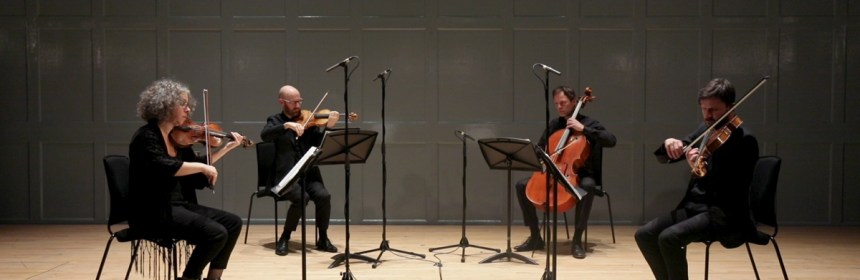
By far the most familiar music of the programme came at the heart of the central work: Samuel Barber’s String Quartet in B Minor. It is quite possible to prefer the original version of the Adagio for Strings in the work’s slow movement (much more edgy than the string orchestra arrangement, and not lush at all) and still have reservations about the context in which it appears. The work had a vexed gestation and some of its more startling details still jar, including the surprising viola figure that punctuates the abrupt ending of the first movement, and the sense of incompleteness about the brief final version of the finale. However Stephanie Gonley, Gordon Bragg, Felix Tanner, and Eric de Wit, although not a seasoned foursome, produced as communicative an interpretation as one might hope to hear, and the presentation was enhanced by some highly-skilled camera-work, with matching shifts of focus.
Keith Bruce